Guide Book Category: Life in the City Sites
-
1000 Broadway Building – 1992
In the heart of downtown Portland, Oregon, stands the 1000 Broadway Building. This tall, modern office building is not just a place where people work—it’s also home to a fascinating secret in its lobby: an echo chamber that surprises visitors with its cool sound effects.
About the Building
The 1000 Broadway Building was built in 1992 and is located at 1000 SW Broadway. It’s a Class A office building, which means it’s high-quality and well-maintained.
One of the most interesting features of the building is found in the lobby. There’s a special area designed to create an echo chamber. When you stand in the right spot and speak, your voice bounces off the curved walls and comes back to you. It’s like hearing yourself talk twice! This happens because of the way sound waves reflect off hard surfaces. The design uses acoustic physics, which is the science of how sound travels.
Most office buildings don’t have fun features like this. The echo chamber makes the 1000 Broadway Building unique. It shows how architecture can mix function (usefulness) with fun. People who visit often try it out by whispering or talking to hear their voices bounce back.
_____________________________________________________________________________
Discussion Questions
Why do you think the designers included an echo chamber in the lobby?
What would you add to a building to make it more fun or interesting?
Vocabulary
Echo chamber – a space where sound bounces back to the speaker
Acoustic physics – the science of sound and how it moves
Lobby – the entrance area of a building
Architecture – the design and construction of buildings
_____________________________________________________________________________
State Education Standards:
Social Studies 3.11. Describe how individuals, groups, events, and developments have shaped the communities and regions. Historical Knowledge
Social Studies 3.12. Compare and contrast the history of the local community to other communities in the region. Historical Knowledge
Social Studies 3.13. Identify how people, places, and environments change over time. Historical Knowledge
Social Studies 3.17. Use a variety of historical sources (artifacts, pictures, documents) to identify factual evidence. Historical Thinking
Social Sciences 3.7. Describe how human activities affect the environment and how the environment affects human activities.
Visual Arts 3.2. Describe how art reflects the time and culture in which it was made.
(Students connect modern architecture to today’s design, technology, and lifestyle.)
,
-
Farrell Sycamore 1880
A Living Piece of Portland’s History
Introduction
The Farrell Sycamore is a special tree located in Portland’s South Park Blocks. It’s not just any tree—it’s a Heritage Tree, which means it has been officially recognized for its historical and environmental importance. This tree helps tell the story of Portland’s past and shows how nature and city life can grow together.
History of the Farrell Sycamore
The Farrell Sycamore is a London Plane Tree, a type of sycamore known for its large size and ability to live in cities. It was planted in the South Park Blocks in 1880 and became Portland’s second Heritage Tree.
The tree was named after someone important to Portland’s tree history, though the exact reason for the name is not fully known. What makes it special is its age, size, and connection to the city’s efforts to protect trees. In 1993, Portland started its Heritage Tree program to honor trees that are old, large, rare, or historically meaningful.
Conclusion
The Farrell Sycamore is a symbol of Portland’s respect for nature and history. By learning about trees like this one, we can understand how our environment connects to the past and how we can protect it for the future.
______________________________________________________________________________
Discussion Questions
Why do you think cities like Portland choose to protect certain trees as Heritage Trees?
What are some ways we can take care of important trees in our own neighborhoods?
Vocabulary
Heritage Tree: A tree officially recognized for its age, size, type, or historical importance.
Sycamore: A type of tree known for its broad leaves and strong trunk.
Urban Forestry: The care and management of trees in cities.
Cultural District: An area with museums, theaters, and public art.
______________________________________________________________________________
State Education Standards:
Social Studies 3.11. Describe how individuals, groups, events, and developments have shaped the communities and regions. Historical Knowledge
Social Studies 3.12. Compare and contrast the history of the local community to other communities in the region. Historical Knowledge
Social Studies 3.13. Apply research skills and technologies to gather information about the past in a region. Historical Thinking
Science 3.2. Develop models to describe that organisms have unique and diverse life cycles but all have in common birth, growth, reproduction, and death. Life Science
,
-
First Congregational Church – 1851
(Checkerboard Church)
1126 SW Park Ave.
Introduction
The First Congregational Church is sometimes referred to as the Checkerboard Church because of its exterior design. It is an important place of worship that has a rich history and a strong community. Established in the mid-19th century, it has played a significant role in the spiritual life of Portland and has contributed to local efforts in social justice and community service.
History
The church was founded in 1851, making it one of the oldest churches in the city. Its founders were a group of people who wanted to create a supportive and welcoming space for everyone, regardless of their background. The first church was built close to the river on stilts to prevent it from flooding.
Twenty years later in 1871, the congregation built a bigger church on the same spot but it burned down in the Great Fire of 1873. The Great Fire destroyed 22 blocks of downtown Portland. About 100 retail stores, 250 homes, and several important public buildings were burned, including the church.
In 1891 (the date on the cornerstone), construction began on a new structure in the classical architectural style, which still stands and is used today. It’s far from the river so it won’t flood, and it’s built from basalt and sandstone so it won’t burn. This building is not only a place for worship but also a historical landmark in Portland. Originally there were four towers on the church but only the bell tower remains. The other three steeples were structurally damaged by age, pigeon droppings, and mildew. They were removed in 1951. The bird droppings measured 16 inches deep in those towers and filled 75 disposal sacks.
Interior Description
Upon entering the First Congregational Church, visitors are often awed by the beauty and warmth of the interior. The sanctuary features high, vaulted ceilings supported by impressive wooden beams, giving a sense of openness and grandeur. Some of the doors are covered in leather with brass rivets. The stained glass windows, created by the renowned Povey Brothers, fill the space with colorful light. These windows depict various biblical scenes and significant figures, adding a spiritual narrative to the artistic ambiance. The Povey Brothers’ logo was a white lily which you can see on several windows. The windows shaped like kites can be opened. This was necessary to cool the church in the days before air conditioning. Look for the Povey Brothers’ signature on the lower right hand side of the south facing window.
Some wooden pews were dedicated to community members who donated money to the church. For example, Frank Beach, who gave Portland its first rose bushes, has his own pew with his name on it (4th row on the right when facing the stage). The border on the wooden pews contains a very significant architectural design called egg and dart. The egg signifies the beginning of life and the dart signifies death. You can see this design on many Portland buildings, including inside City Hall.
Exterior Description
When the rest of the block was developed, congregants thought it was important to construct buildings that were complementary to the historic church design with its checkerboard pattern, construction material, and dimensions. The checkerboard design is repeated on the sidewalk in front of the Portland’5 Center for the Performing Arts. Notice that the faces of the people in the stained glass windows have no facial features.
The Bell
The bell, which is from the original church, weighs 2500 pounds. It’s so heavy that when the rope is pulled to ring the bell, it lifts the person ringing the bell off their feet. The church rang the bell 200 times in 1976 to commemorate the 200th birthday of our country.
_____________________________________________________________________________
Discussion Questions:
Why do you think it’s called the checkerboard church?
What other famous logos can you think of?
Vocabulary
Povey Brothers
Egg and dart
________________________________________________________________
State Education Standards:
Social Studies 3.11. Describe how individuals, groups, events, and developments have shaped the communities and regions. Multicultural Studies, Historical Knowledge
Social Studies 3.12. Compare and contrast the history of the local community to other communities in the region. Historical Knowledge
Social Studies 3.13. Apply research skills and technologies to gather information about the past in a region. Historical Thinking
Social Studies 3.14. Explain why individuals and groups in the same historical period differed in how they viewed and interpreted events. Historical Perspective
,
-
Frank E. Beach
The Man Behind Portland’s “City of Roses”
Portland, Oregon has many nicknames—Stumptown, Puddletown, Rip City, and Bridgetown—but one of the most beautiful is the City of Roses. This name was inspired by Frank E. Beach, a local newspaper editor and visionary who believed Portland should be known for its stunning rose gardens and community spirit.
History and Contributions
Frank E. Beach lived from 1853 to 1934 and played a key role in shaping Portland’s identity. In the early 1900s, he noticed how well roses grew in the city’s mild climate. He began promoting the idea that Portland should be called the “City of Roses.” But he didn’t stop there—he also proposed an annual Rose Festival, a celebration that still happens today and includes parades, music, and floral displays. In 1905 the city planted 20 miles of roses to attract people to the World’s Fair in Portland.
What Is Stumptown? Before Portland became the City of Roses, it was known as Stumptown. In the mid-1800s, the city grew quickly, and trees were cut down to make room for buildings. The streets were filled with tree stumps, giving the city its rough nickname. Eventually the stumps were removed, but this left large holes in the ground which filled with rain, thus the name Puddletown. Over time, Portland transformed from a rugged frontier town into a vibrant city full of art, gardens, and culture.
Frank E. Beach’s ideas helped shape Portland’s identity. From Stumptown’s rough beginnings to the blooming City of Roses, his vision continues to inspire pride and beauty in the heart of Oregon.
___________________________________________________________
Discussion Questions
Why do you think Frank E. Beach wanted Portland to be known as the City of Roses?
How does a city’s nickname affect how people see it?
If you could give your city a new nickname, what would it be and why?
Why is Portland called Bridgetown? Rip City?
Vocabulary
Visionary: Someone who has creative ideas about the future.
Memorial: Something that honors a person who has passed away.
Festival: A special event with celebrations, often held every year.
____________________________________________________________
State Education Standards:
Social Studies 3.11. Describe how individuals, groups, events, and developments have shaped the communities and regions. Historical Knowledge
Social Studies 3.13. Apply research skills and technologies to gather information about the past in a region. Historical Thinking
Social Studies 3.14. Explain why individuals and groups in the same historical period differed in how they viewed and interpreted events. Historical Perspective
,
-
Heathman Hotel – 1927
SW Broadway and SW Taylor
The Heathman Hotel is a historic hotel located in downtown Portland, Oregon. It first opened in 1927 and quickly became an important part of the city’s cultural and social life. The hotel is located near theaters, concert halls, and art spaces, making it a popular place for visitors who enjoy the arts.
Outside the Heathman is a statue of Zelda the Dog. In the lobby of the Heathman there is an old post box and the columns in the lobby contain replicas of the Portland penny.
Over the years, the Heathman Hotel has welcomed many writers, musicians, and performers. The hotel is especially known for its large library, which reflects Portland’s strong connection to literature and learning. The beautiful polished wood in the main area of the hotel is eucalyptus imported from Australia. The chandelier in the main room is unique. There are only 6 like it in the world. Four of them are in the U.S. Embassy in Vienna, Austria and one is in New York. Many of the books in the library are signed by authors who stayed at the hotel.On the second floor of the hotel all the meeting rooms are named after Portland bridges. There is also a secret passage that connects the hotel to the Arlene Schnitzer Concert Hall next door. Famous authors and musicians who stay at the hotel can access the theater through this passage.
The building’s architecture and interior design feature rich wood details and classic craftsmanship from the early 20th century. Today, the Heathman Hotel remains a landmark that represents Portland’s hospitality, history, and love of the arts._______________________________________________________________________
Discussion Questions
Why do cities preserve historic hotels like the Heathman?
How can a hotel become part of a city’s culture?
Why might artists enjoy staying at the Heathman Hotel?
What historic buildings are important in your community?Vocabulary
Historic – Important in history.
Hospitality – Friendly and generous treatment of guests.
Culture – The arts, traditions, and ideas of a community.
Architecture – The design and style of buildings.
Landmark – A well-known or important place.________________________________________________________________________
State Education Standards:
Social Studies 3.11. Describe how individuals, groups, events, and developments have shaped the communities and regions. Historical Knowledge
Social Studies 3.12. Compare and contrast the history of the local community to other communities in the region. Historical Knowledge
Social Studies 3.17. Use a variety of historical sources (artifacts, pictures, documents) to identify factual evidence. Historical Thinking
,
-
John Helmer Haberdashery – 1927
969 SW Broadway
Introduction
John Helmer Haberdashery is a historic men’s clothing store located on SW Broadway in downtown Portland. John Helmer, a Swedish immigrant, opened the store in 1921 on SW Washington St., a place once called “Menswear Row.” In 1927, he moved the store to its current location. He wanted to bring quality clothing and accessories to a growing city. The store has remained in the same family for three generations and is still operating today.
Founder’s Immigrant Story
John Helmer came to Portland from Sweden, part of a wave of immigrants who helped shape the city’s culture and economy. His first job was as a valet to a rich man. A valet takes care of a gentleman’s clothing. His store became a place where men could buy suits, hats, ties, scarves, socks, and other accessories to look professional and stylish.
The immigrant background of the Helmer family shows how newcomers contributed to Portland’s business life.
Store History and Legacy
In the 1930s, there were 16 men’s clothing shops downtown, but most disappeared over time. John Helmer Haberdashery survived by finding its niche. The store became especially famous for its huge selection of hats, from classic fedoras to Viking helmets!
Today, it is run by John Helmer III, the founder’s grandson, who took over the store in 1982 from his father and continues the tradition of personalized service.
Fun Facts
The store sold real Viking helmets made of metal and bone. These are not costumes.
John Helmer III worked in the store as a child, even breaking down boxes in the basement before child labor laws became stricter.
___________________________________________________________________________
Discussion Questions:
Why do you think John Helmer Haberdashery survived when so many other clothing stores closed?
How does the immigrant story of John Helmer connect to Portland’s history?
How does shopping at a small, family-run business feel different from shopping at a large department store?
Vocabulary
Haberdashery – A shop that sells men’s clothing accessories like hats, ties, and scarves.
Immigrant – A person who moves to another country to live and work.
Legacy – Something handed down from the past, like a family business.
Niche – A special area of focus that helps a business succeed.
Accessories – Extra items of clothing that add style, such as hats or belts.
_____________________________________________________________________
State Education Standards:
Social Studies 3.11. Describe how individuals, groups, events, and developments have shaped the communities and regions. Historical Knowledge
Social Studies 3.12. Compare and contrast the history of the local community to other communities in the region. Historical Knowledge
Social Studies 3.13. Apply research skills and technologies to gather information about the past in a region. Historical Thinking
,
-
Lewis & Clark Mural – 1989
1207 SW Broadway
The Lewis and Clark mural is located on the Sovereign Hotel in downtown Portland and overlooks the Oregon Historical Society plaza. The mural is painted using a special artistic technique called trompe l’oeil, a French phrase meaning “to fool the eye.” This technique makes painted images appear three-dimensional. By using trompe l’oeil, the artist turned the side of the Sovereign Hotel into a visual history lesson. The mural connects art, architecture, and history while reminding viewers of Portland’s connection to early exploration.
The mural shows scenes inspired by the Lewis and Clark Expedition, which explored the western United States in the early 1800s. President Thomas Jefferson bought land called the Louisiana Purchase from Napoleon. This is the land he asked Lewis and Clark to explore from 1804 to 1806. The expedition covered 8000 miles on rivers and on foot. There were 43 people in the expedition and only one died – from appendicitis.On the left, the mural depicts Merriwether Lewis and Sacajawea holding her baby Jean Baptiste Charbonneau. On the right is William Clark, his dog Seaman, and his slave York. Sacajawea was married to Toussaint Charbonneau, a French trapper, whom the expedition hired as its guide. Sacajawea was a very valuable addition to the expedition. She provided critical translations with the tribes they encountered on the expedition. Her presence signalled a peaceful, non-warrior party to native tribes. York was a valuable contributor to the expedition and although he was promised his freedom at the end of the journey, Lewis never set him free.
________________________________
Discussion Questions:
Why might an artist use trompe l’oeil on a large building?
How does this mural change the way people see the hotel?
Why is public art important to a city?
What other historical events could be shown in murals?Vocabulary
Mural – A large painting on a wall or building.
Trompe l’oeil – An art technique that creates the illusion of three-dimensional objects.
Expedition – A journey taken for a specific purpose, such as exploration.
Perspective – The way objects appear smaller or larger depending on distance.
Landmark – An important or well-known place._______________________________________
State Education Standards:
Social Studies 3.11. Describe how individuals, groups, events, and developments have shaped the communities and regions. Historical Knowledge
Social Studies 3.12. Compare and contrast the history of the local community to other communities in the region. Historical Knowledge
Social Studies 3.17. Use a variety of historical sources (artifacts, pictures, documents) to identify factual evidence. Historical Thinking
,
-
Mark O. Hatfield U.S. Courthouse – 1997
1000 SW 3rd Ave. Law of Nature Sculpture Garden
The Mark O. Hatfield U.S. Courthouse is located along S.W. 3rd Ave. It serves as a federal courthouse where important legal cases are heard. The building is named after Mark O. Hatfield, a longtime Oregon senator.In a patio on the 9th Floor of the courthouse is a sculpture garden called Law of Nature. This artwork shows how laws and justice are connected to fairness, balance, and nature. It depicts a jury trial with an owl as a judge, a dog as an attorney and a cat on trial. The jury consists of other animals. Together, the courthouse and sculpture represent the importance of law, democracy, and public service in Portland.From the 16th floor, you can see nearly all of downtown Portland.
_____________________________________________________________
Questions for Discussion
Have you read stories where animals take the form of humans?
What do you think about the animals and their roles in the trial?
VocabularyCourthouse – A building where legal cases are heard.
Justice – Fair treatment according to the law.
Sculpture – A three-dimensional work of art.
Democracy – A system of government run by the people.
Senator – An elected government official.__________________________________________________________________
State Education Standards:
Social Studies 3.11. Describe how individuals, groups, events, and developments have shaped the communities and regions. Historical Knowledge
Social Studies 3.12. Compare and contrast the history of the local community to other communities in the region. Historical Knowledge
Social Studies 3.17. Use a variety of historical sources (artifacts, pictures, documents) to identify factual evidence. Historical Thinking
,
-
Plaza Blocks
Introduction
The Plaza Blocks are a group of three public parks located in downtown Portland. They include Terry Schrunk Plaza, Chapman Square, and Lownsdale Square. Even though they sit close together, each plaza has its own history and special purpose. Together, they form an important part of Portland’s civic life, giving people a place to gather, relax, and enjoy the city.
Terry Schrunk Plaza
Terry Schrunk Plaza is named after former Portland mayor, Terry Schrunk. It sits across from City Hall and is owned by the federal government. The plaza has a large open space where events, rallies, and public speeches often take place. Below the plaza is a parking garage. If you stand in the circle at the center of the plaza and speak, your voice will echo.
Chapman Square
Chapman Square is one of the oldest public squares in Portland. It was created in the 1800s and was originally designed for women and children during a time when parks were sometimes separated by gender. Today, Chapman Square is a quiet, green space filled with trees, paths, and benches. The square is known for its historic statues and landscaping. It also hosts public events, including rallies and cultural celebrations. Chapman Square helps bring natural beauty into the middle of downtown.
Lownsdale Square
Right across from Chapman Square is Lownsdale Square. In the 1800s, this plaza was intended for men only, but today it is open for everyone. Lownsdale Square includes tall elm trees, grassy areas, and monuments, including a well-known statue called the Soldiers Monument, which honors Oregon soldiers who fought in the Spanish American War (1898). Like the other plazas, Lownsdale Square is used for public gatherings and is an important part of Portland’s history.
Thompson Elk Fountain
See the report on the fountain for information on its importance and why it was placed in this location.
____________________________________________________________________________
Questions for Discussion
Why is it important to have parks in the middle of a city?
Why do The Plaza Blocks matter?
How are the 3 parks different from each other?
Plaza Blocks were named after good citizens. How can you be a good citizen?
Vocabulary
Protest, rally, public speaking and debate
State Education Standards:
Social Studies 3.11. Describe how individuals, groups, events, and developments have shaped the communities and regions. Historical Knowledge
Social Studies 3.12. Compare and contrast the history of the local community to other communities in the region. Historical Knowledge
Social Studies 3.17. Use a variety of historical sources (artifacts, pictures, documents) to identify factual evidence. Historical Thinking
,
-
Portland Building – 1982
1120 SW 5th Ave.
The Portland Building is a well-known government building located in downtown Portland, Oregon. It was completed in 1982 and is famous for its bold colors, decorative shapes, and unique design. The building was designed by architect Michael Graves.
Unlike many plain office buildings, the Portland Building was created to be artistic and expressive. It’s one of the first post-modern buildings in the United States and its design helped introduce postmodern architecture, a style that uses color and decoration to make buildings more interesting. Today, the Portland Building remains an important example of modern architecture in the city, and people either love it or dislike it. It’s the most controversial building in Portland.________________________
Discussion Questions:
Why do you think some people like bold building designs? Do you like this building or do you dislike it? Why?
How does architecture affect how people feel about a city?
Why might a city want an artistic government building?
What modern buildings stand out in your community?Vocabulary
Architecture – The art and science of designing buildings.
Postmodern – A style that includes decoration, color, and creativity.
Architect – A person who designs buildings.
Landmark – A well-known or important place.
Government – The group of people who manage a city or country.________________________________________________________________
State Education Standards:
Social Studies 3.11. Describe how individuals, groups, events, and developments have shaped the communities and regions. Historical Knowledge
Social Studies 3.12. Compare and contrast the history of the local community to other communities in the region. Historical Knowledge
Social Studies 3.17. Use a variety of historical sources (artifacts, pictures, documents) to identify factual evidence. Historical Thinking
,
-
Portland City Hall – 1895
1221 SW 4th Ave.
Portland City Hall: A Historic Landmark with a Ringing Legacy
Portland City Hall is more than just a government building—it’s a symbol of civic pride and a place where important decisions are made. Built in 1895, this beautiful structure has served as the center of city government for over a century. With its grand architecture, fascinating artifacts, and deep roots in civic life, City Hall is a place worth learning about.
The Heart of City Government
City Hall is where Portlanders’ voices are heard. It houses the offices of the mayor and city councilers, and it’s where public meetings and hearings take place. Portlanders come here to share ideas, solve problems, and help shape the future of their city. City Hall represents democracy, where everyone has a chance to be involved.
“Good Citizens are the Riches of a City” a quote by C.E.S.Wood., engraved on the Skidmore Foumntain.
To be a good citizen, kids can follow these simple guidelines:
Be Kind: Treat others with respect and kindness, no matter their differences.
Help Others: Offer assistance to friends, family, and community members in need.
Follow Rules: Abide by school and community rules (laws) to create a safe environment.
Participate: Get involved in school activities and community events to contribute positively.
Be Responsible: Take care of your belongings and complete your chores and homework on time.
Respect Nature: Take care of the environment by recycling and not littering.
The Liberty Bell Replica
Outside the east entrance of City Hall stands a replica of the famous Liberty Bell. The original bell in Philadelphia is a symbol of American freedom, and Portland wanted one of its own. The first replica arrived in 1963 but was sadly destroyed in a bombing in 1970. A second replica was installed in 1975, made of bell metal—a special copper alloy—and weighs about one ton! It’s now a veterans memorial, honoring those who served the country.
When it came to funding for the new Liberty Bell, the community decided to raise the money, many people were involved. School children across the city joined this effort. Many students donated small coins – often just pennies – to help pay for the replacement. Each gift was small, but together they helped make the new bell possible.
The Time Capsule
Inside the lobby of City Hall, there’s a time capsule that was sealed in the floor in 1998 and will be opened in 2098. A time capsule is a container filled with items from the present, meant to be opened in the future. It holds newspapers, letters, and other objects that tell the story of Portland’s past. It’s like a message to people in the future, showing them what life was like in former times.
____________________________________________________________________________
Discussion Questions
Why do you think Portland wanted its own Liberty Bell?
What would you put in a time capsule to represent life today?
How does City Hall help connect people to their city’s history?
Why is it important for Portlanders to have a place like City Hall?
Vocabulary
Replica – A copy of something, often made to look exactly like the original.
Veterans Memorial – A monument or object that honors people who served in the military.
Time Capsule – A container storing items from the present to be opened in the future.
Democracy – A system of government where people have the power to make decisions.
_____________________________________________________________________________
State Education Standards:
Social Studies 3.11. Describe how individuals, groups, events, and developments have shaped the communities and regions. Historical Knowledge
Social Studies 3.12. Compare and contrast the history of the local community to other communities in the region. Historical Knowledge
Social Studies 3.13. Apply research skills and technologies to gather information about the past in a region. Historical Thinking
,
-
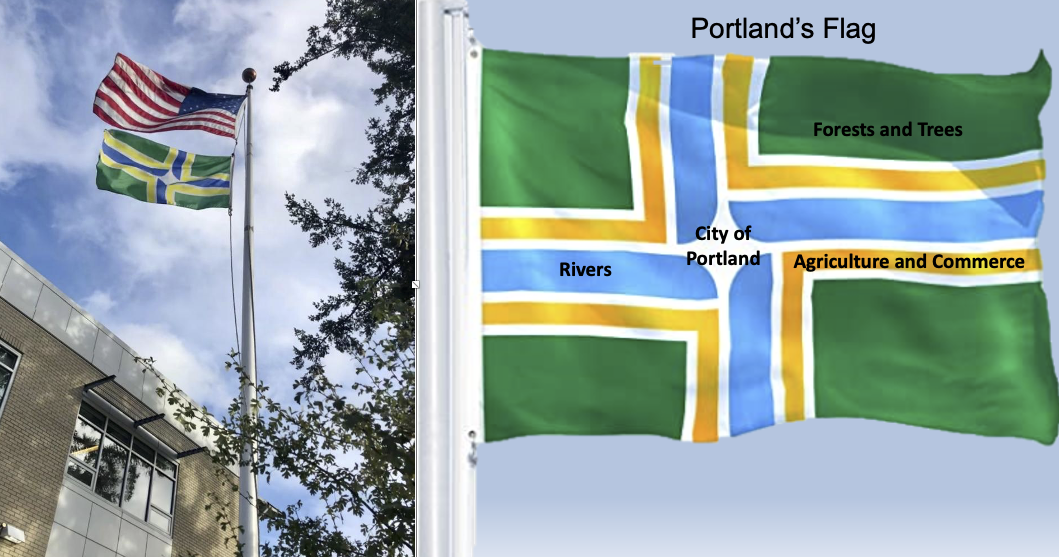
Portland Flag
Portland flag The Portland flag, designed in 1969, is a symbol that represents the city of Portland, Oregon. It features a green background with a white star in the center and blue and yellow intersecting lines. Each part of the flag has a special meaning connected to the city.The blue lines represent the Willamette and Columbia Rivers that flow through Portland. The green background stands for the surrounding forests and the city’s parks.
The white star signifies Portland where the Willamette River and Columbia Rivers meet.
The yellow lines symbolize agriculture and commerce.
The flag reflects Portland’s identity and values as a river and forest city.
______________________________________________
Discussion Questions:
Why do cities use symbols like flags?
How does the Portland flag show the city’s values?
What symbols would you choose for a city flag?
Why is nature important to Portland’s identity?Vocabulary Words
Symbol – Something that represents an idea or place.
Identity – What makes a place unique.
River – A large natural stream of water.
Design – The way something is planned or created._______________________________________________________
State Education Standards:
Social Studies 3.11. Describe how individuals, groups, events, and developments have shaped the communities and regions. Historical Knowledge
Social Studies 3.12. Compare and contrast the history of the local community to other communities in the region. Historical Knowledge
Social Studies 3.14. Explain why individuals and groups in the same historical period differed in how they viewed and interpreted events. Historical Perspective
,
-
Portland‘5 Centers For The Arts – 1928
1111 SW Broadway
Introduction
The Portland’5 Centers for the Arts is a large arts venue in downtown Portland, Oregon. It includes several theaters and houses many concerts, plays, dances, and other performances each year.
Arlene Schnitzer Concert Hall
One of the most famous buildings in the group is the Arlene Schnitzer Concert Hall. It was built in 1927 and originally called the Portland Publix Theatre, then the Paramount Theatre, before being renamed for Arlene Schnitzer in 1984. The hall has beautiful Italian Rococo Revival architecture and seats about 2,776 people.
On the outside of the Schnitzer Concert Hall you’ll find the iconic PORTLAND sign. This sign is very tall (about 65 feet high) and has neon lights. It was first installed when the building opened as the Portland Publix. Three years later Paramount Movie Company bought the theater and changed the sign to say Paramount. At that time the sign contained 7000 light bulbs. The sign was rebuilt in 1984 to say Portland again and now contains 1100 LED bulbs. Years ago there were problems with the sign. Electricians discovered that bees had made a home in the sign and there were hundreds of gallons of honey inside the sign. It had to be rebuilt again. The sign is a landmark and local favorite in Portland.
Here’s another anecdote about the Schnitzer. If you look through the windows, you can see a white marble statue. It’s called Surprise and it was in the original theater in 1927. Soon after the theater opened, an unemployed actor stole the cash box and a gunfight broke out in the lobby. No one got hurt but someone shot off two fingers on the statue’s hand. Those fingers were not glued back on until 1984 – 57 years later!
Antoinette Hatfield Hall
Right across the street is Antoinette Hatfield Hall. This hall is part of the Portland’5 group and houses three theatres: The Newmark, the Winningstad and the Brunish. The architect who designed the building created the lobby to look like an Elizabethan theater. The lobby makes you feel like you are on stage. Look up and imagine people sitting in the boxes looking down on you.
In the lobby of Hatfield Hall there is a special sculpture called Mago Hermano (Brother Wizard or Magician) by Mexican artist Alejandro Colunga. Portland’s Sister City, Guadalajara, Mexico, gave Portland the statue as a gift. It features a whimsical bronze and steel figure with many Northwest features (roses, a ball with water, a nose like a water spigot, antlers, slugs, etc.). The statue adds a fun international art element to the space.
While in the lobby look up to see the Spectral Light Dome. The dome is comprised of 500 pieces of clear glass that are treated with a chemical that picks up the light and gives the dome color. The architect also wanted the lobby to feel like theaters in ancient Greece and Rome which had open domes to the sky.
Outside on the street next to these buildings (SW Main Street between Broadway and Park Avenue), there is another fun art installation called the Folly Bollards. They are twenty bronze busts mounted on waist-high posts, showing 10 different spirits or mythical characters from literature and story-telling from around the world. They were installed in 1998. They are there to decorate the space and make it fun. Also note the repeated checkerboard pattern in the sidewalk that repeats the pattern on the historic First Congregational Church.
In addition, there are stars on the sidewalk between the two theaters. Each star contains the name of a person who made a great contribution to our city. Remember, good citizens are the riches of the city.
___________________________________________________________________________________
Discussion Questions:
What are some symbols of Portland depicted in the Mago Hermano?
What is a sister city? Why are they important?
___________________________________________________________________________________
State Education Standards:
Social Studies 3.11. Describe how individuals, groups, events, and developments have shaped the communities and regions. Historical Knowledge
Social Studies 3.12. Compare and contrast the history of the local community to other communities in the region. Historical Knowledge
Social Studies 3.13. Apply research skills and technologies to gather information about the past in a region. Historical Thinking
,
-
South Park Blocks
Historic Green Heart of the City
Introduction
The South Park Blocks in Portland, Oregon, are a beautiful stretch of green space that runs through downtown. This multi-block park is more than just a place to relax—it’s a part of Portland’s history and culture. With tall trees, public art, and nearby museums and schools, the South Park Blocks are a special place for both locals and visitors.
A Walk Through History
The South Park Blocks, originally called The Boulevard, were first planned in 1852 by Daniel H. Lownsdale, who wanted to create a public space for people to enjoy. He donated nineteen original blocks to the city, which later became part of Portland’s first official parkland. Over time, the area grew into a fancy neighborhood with big houses, churches, and schools. Teenage boys used to race their horses along these blocks. In the 1870s, the city began planting trees and flowers to make the park more beautiful. By 1908, the park was filled with colorful plants and statues. Today, the park is home to over 300 trees, including elm, oak, and maple, and many pieces of public art.
Culture and Community
The South Park Blocks are part of Portland’s Cultural District, which includes the Portland Art Museum, Portland State University, and many theaters. The park is used for community events, a farmers’ market every Saturday, peaceful walks, and even streetcar rides. It’s also listed on the National Register of Historic Places, showing how important it is to the city’s history.
Public Art
The South Park Blocks are full of surprises, and two pieces of public art there—Transcendence and Star Catcher—show how creativity can make a city feel magical. These artworks are not just decorations; they tell stories and make people think. Let’s explore what makes them special.
Transcendence: A Flying Fish?
Transcendence is a bronze sculpture by artist Keith Jellum. It shows a giant salmon swimming through the corner of a brick building above Southpark Seafood Restaurant on SW Salmon Street which is named after the salmonberry. The fish is 11 feet long, and it looks like it’s leaping right through the wall! This sculpture is whimsical, which means it’s playful and a little strange—in a fun way. It reflects Portland’s love for quirky and unexpected art.
Salmon is important in Oregon’s culture and environment. By placing it above a seafood restaurant on Salmon Street, the artist adds humor and meaning. The sculpture makes people stop, look up, and smile. It’s a reminder that art can be surprising and joyful.
Star Catcher: Reaching for Dreams
Star Catcher is a colorful mural painted on a building in the South Park Blocks. It shows a young girl reaching out to catch stars in the sky. The stars represent hopes, dreams, and imagination. The mural uses bright colors and bold shapes to grab attention and inspire viewers. It celebrates childhood wonder and the idea that anyone can reach for something greater. Located in a busy area, it can be seen by many people every day. It helps make the city feel more alive and hopeful.
These two artworks show how public art can make a city more interesting and meaningful. Whether it’s a fish flying through a wall or a girl catching stars, Portland’s South Park Blocks remind us that imagination is everywhere.
The South Park Blocks are a great example of how nature, history, and community can come together in one place. Whether you’re walking under the trees, admiring the statues, or attending a local event, this park is a living part of Portland’s story.
______________________________________________________________________________
Discussion Questions:
Parks:
Why do you think Daniel Lownsdale wanted to create park blocks in Portland?
How do parks like the South Park Blocks help bring communities together?
What kinds of events or activities would you enjoy in a park like this?
Art:
Why do you think the artist chose a salmon for Transcendence?
How does Star Catcher make you feel when you look at it?
What are some other examples of public art you’ve seen in your city?
Do you think art should be fun and surprising, or serious and thoughtful? Why?
_____________________________________________________________________________
State Education Standards:
Social Studies 3.11. Describe how individuals, groups, events, and developments have shaped the communities and regions. Historical Knowledge
Social Studies 3.12. Compare and contrast the history of the local community to other communities in the region. Historical Knowledge
Social Studies 3.17. Use a variety of historical sources (artifacts, pictures, documents) to identify factual evidence. Historical Thinking
VA:Re8.1.3a. Interpret art by referring to contextual information and analyzing subject matter, form, and materials. Visual Arts Responding
,
-
Standard Building – 1963
1100 SW 6th Ave.
Introduction
The Standard Plaza (or Standard Building) is a tall office building in downtown Portland, Oregon. On its roof sits a very special weather beacon — a set of lights that forecast the weather. Even though we now have weather apps, this colorful beacon still shines and is a piece of Portland history.
History
When the Standard Plaza opened in 1963 it was the largest office building in Oregon. The building was designed by a well-known architecture firm, Skidmore, Owings & Merrill, in what is called the “international style.” Over the years, the building has been improved: in 2009, it earned a gold rating for being energy-efficient. There are also electric car charging stations in its parking garage.
The Weather Beacon
On top of the building is a 50-foot tall weather beacon, which makes the total height of the building about 275 feet. The beacon changes color to tell people about the forecast: Red lights mean the temperature is expected to go up by about 5 degrees or more. Green means the temperature will stay about the same (within 5 degrees). White means the temperature will drop by about 5 degrees or more. It also communicates precipitation: if the beacon blinks, that means rain (or some kind of precipitation) is expected. The lights are updated twice a day using weather data from the National Weather Service. Inside the building (in both the lobby and basement), there is a control panel that shows the same pattern as the lights on top. The idea for the beacon came in an earlier era (1950s-60s), when beacons were more common. They helped people plan their day by knowing the weather forecast.
The beacon is a piece of local history. Even though most people now check the weather on their phones, this beacon still operates. It also shows how architecture and design can be functional and artistic — giving information in a way that becomes part of the skyline.
______________________________________________________________________________
Discussion Questions:
Why do you think the Standard Building’s weather beacon is still maintained, even though weather apps are so common?
If you could add a modern twist to the beacon (for example, adding digital information, wind speed, or air quality), what would you design?
______________________________________________________________________________
State Education Standards:
Social Studies 3.11. Describe how individuals, groups, events, and developments have shaped the communities and regions. Historical Knowledge
Social Studies 3.12. Compare and contrast the history of the local community to other communities in the region. Historical Knowledge
Social Studies 3.17. Use a variety of historical sources (artifacts, pictures, documents) to identify factual evidence. Historical Thinking
,
-
Thompson Elk Statue
SW Main between SW 3rd and 4th Streets
The Thompson Elk Fountain was built in 1900 and named for its benefactor, David P. Thompson, who served as Portland’s mayor from 1879 to 1882. A founding director of the Oregon Humane Society, Thompson wanted to pay homage to the wildlife that once roamed the city. In 1899, inspired by Portland’s first work of public art, Skidmore Fountain, he proposed to the Mayor and City Council a “monument to Oregon Humane Society” to be “of benefit to humanity and the dumb animals . . .”The bronze elk—which stands 9 feet tall and weighs 3,000 pounds—was sculpted by Roland Hinton Perry. The granite base and water-spouting fountain were designed and built by H. G. Wright.
The Thompson Elk Fountain has long been a community gathering place and a hub of activism for Portlanders. People have gathered at the fountain for generations not only to appreciate the artistry of the City’s second-oldest piece of public art but also to exercise free speech and engage in protest. In restoring the fountain, the City acknowledges this history and works to promote healing and inclusion.
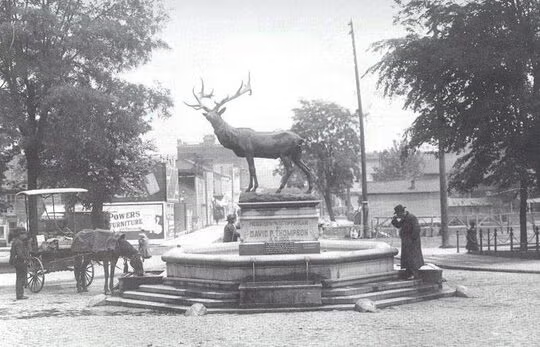
An archival photo of a horse drinking from the Thompson Elk Fountain.
Learn more about the history of the Thompson Elk Fountain.
Source: https://www.portland.gov/water/improvements/construction/thompson-elk-fountain-restoration-project
,
-
Horse Drawn Street Cars – 1872 – 1889
Trolley Street – SW First Ave.
The story of Portland’s early horse-drawn streetcars begins in 1872, when the city was still small and most people walked wherever they needed to go. As businesses and houses spread out from the riverfront, walking became harder, especially in muddy winter weather. To solve this problem a local businessman built the city’s first horse-drawn streetcar line. The line ran along First Street through the downtown business district.
The first route was only about two miles long. The cars ran on iron rails set into the street and were pulled by one or two horses. Even though the cars were not very fast, they were more comfortable than walking in the mud and rain.
Fares were low enough that many workers could afford them, and the trolleys helped connect neighborhoods to the downtown area. Because the cars followed fixed rails, they were smoother and safer than regular wagons on rough streets.
However, horse-drawn streetcars had problems. Horses got tired, needed food and stables, and could not pull heavier cars very far or very fast. By 1889 electric streetcars were introduced. These new electric streetcars were faster, cleaner, and cheaper to run.
Even though they operated for only a few decades, Portland’s early horse-drawn streetcars were very important. They were the city’s first real public transit system and showed people that they did not have to live and work in the same small area. The lines encouraged new neighborhoods, helped businesses grow, and prepared the way for the larger network of electric streetcars that would come next.
Today, when modern streetcars run through downtown Portland, they are part of a long story that began with those small wooden cars, iron rails, and hard-working horses in 1872.
Note: Discuss horse drawn street cars anywhere along SW 1st and point out Max lines.
_______________________________________________________________________
Discussion Questions:
What were some problems with using horses to pull street cars?
What “streetcar” runs along this street today?
Vocabulary: fixed rails
State Education Standards:
Social Studies 3.1 Examine how different levels of city and county government provide services to members of a community. Civics and Government
Social Studies 3.19 Analyze different ways that people, other living things, and the environment might be affected by an event, issue, or problem. Social Science Analysis
,
-
Portland History Overview
Understanding the history of Portland from its founding to its present day character and development will help guides as they develop their own stories for their tours.
Portland’s history is especially well suited to place-based storytelling. Many of the forces that shaped the city—rivers, trade, transportation, labor, planning, and protest—are still visible in its streets, buildings, bridges, and public spaces. The role of the guide is to help participants connect what they see to why it exists.
Before Portland: Native Peoples, The Clearing, and the River
Why this Section Matters on Tour
Before Portland was a town, a port, or a city, this place already mattered. Thousands of years before streets or buildings, people lived, traveled, traded, and gathered here. This section helps guides explain that Portland’s story did not begin with settlement, but with the land and the rivers—and the Native peoples who knew them best.Indigenous Peoples of the Portland Area
Archaeological and oral history evidence shows that Indigenous peoples have lived in the Pacific Northwest for at least 10,000 years. In the region that would become Portland, life centered on the Willamette and Columbia Rivers, which provided food, transportation, and connection.The Columbia River marked a major cultural and linguistic boundary. Chinookan-speaking peoples, including the Multnomah and Clackamas, lived along the lower Columbia and Willamette Rivers. Kalapuyan-speaking peoples, including the Tualatin, lived south and west in the Willamette Valley. These groups were connected through trade networks long before Europeans arrived.
Living with the Land and Water
Native peoples carefully managed the land through seasonal fishing, gathering, and controlled burning that maintained open areas. The environment was not “untouched wilderness”—it was actively shaped and maintained.Disease, Colonization, and Displacement
European contact brought catastrophic change. Diseases such as smallpox and measles spread rapidly through Native communities in the late 1700s and early 1800s, often before large-scale settlement. As settlement increased, U.S. policies accelerated displacement. The Oregon Donation Land Act of 1850 granted land to white settlers, ignoring Indigenous land use. Treaties and coercion forced many Native peoples onto reservations.The Clearing: a place before a city
On the west bank of the Willamette River was a small open area later known as “The Clearing.” In an otherwise dense forest, this open space stood out. It likely existed because Native peoples maintained it and because it worked as a resting and gathering place along a major river route. Later, trappers, traders, and settlers used the same spot.Rivers as the Constant
The Willamette River is the through-line of Portland’s history. It fed Indigenous communities, drew early settlers, enabled trade and shipping, and shaped where the city grew.Guide Takeaway
Portland exists here because people have been using this river for thousands of years.From Rival Towns to Portland: Why This City Won
Why this Section Matters on Tour
Portland’s rise was not guaranteed. In the mid-1800s, several towns along the Willamette River competed to become Oregon’s leading city. Understanding why Portland succeeded helps participants see the city as the result of choices, investments, and timing—not destiny.A River Full of Competitors
As American settlement expanded in the 1840s, towns sprang up along the Willamette River. Major rivals included Oregon City, Milwaukie, and St. Helens.Oregon City: Early Power, Built-In Barriers
Oregon City had the Willamette Falls for water power and early industry. But the falls blocked navigation for large ships. As shipping increased, Oregon City’s location became a disadvantage.Milwaukie and St. Helens: Strong But Limited
Milwaukie developed mills and shipyards, but struggled to match Portland’s port infrastructure. St. Helens had access to ocean-going ships, but lacked strong inland connections.Portland’s Key Advantage: A Working Harbor
Portland’s success rested on a reliable working harbor. Ships could dock, load, and unload efficiently. At Portland the Willamette River was deep enough to handle ocean going ships of the day. This helped Portland win over other cities farther up river where the water became shallower. Early road connections to the Tualatin Valley linked farms to the port.Investment and Promotion
Portland’s boosters built docks and warehouses, supported roads, and promoted Portland as the place to invest. These choices created momentum.Gold Changes the Game
The California Gold Rush accelerated Portland’s rise by increasing shipping and demand for supplies.Guide Takeaway
Portland won because it worked better for trade—and once it pulled ahead, momentum did the rest.Becoming a City: Fire, Flood, Growth, and Reinvention
Why this Section Matters on Tour
Portland did not grow in a straight line. It grew through crisis, rebuilding, and adaptation. Fires and floods repeatedly damaged the city, while bridges and infrastructure allowed expansion beyond the original waterfront.From Frontier Town to Incorporated City
Portland incorporated in 1851 and began providing basic services. Early streets were muddy, stumps remained for years, and wooden sidewalks were common.Fire: Destruction and Opportunity
With wooden buildings packed near the river, fire was a constant threat. The fires of 1872 and 1873 destroyed large portions of downtown, especially near the waterfront. Rebuilding encouraged brick, stone, and cast iron construction and a more permanent commercial core was developed.Flood: Rethinking the River
The Great Flood of 1894 turned parts of downtown into waterways and reinforced the river’s danger. Over time, Portland shifted major civic and commercial activity slightly inland and uphill.Bridges Transform the City
Bridges changed Portland’s shape. The Morrison Bridge opened in 1887, and the Steel Bridge opened to pedestrians in 1889 (later replaced in 1912). Bridges enabled rapid east-side growth. The annexation of Albina and East Portland in 1891 created a two-sided city.Reinvention as a Pattern
Crisis followed by reinvention is a repeating Portland theme: rebuild stronger, expand infrastructure, and adapt the city’s relationship to the river.Guide Takeaway:
Various crises – fire, flood – forced Portland to rebuild—and rebuild differently.Working Portland: Labor, Immigration, Chinatown, and Skid Road
Why this Section Matters on Tour
Portland was built by working people—loggers, dockworkers, railroad laborers, and service workers. At the same time, the city developed systems of exclusion and inequality that shaped who benefited from growth.A Working Port City
By the late 1800s and early 1900s, Portland depended on lumber, docks, railroads, and processing industries. Work was often seasonal and dangerous, creating a large population of transient laborers.Skid Road: Work, Shelter, and Survival
Skid Road (later “Skid Row”) developed along what is now West Burnside. The name came from greased log roads that slid timber to the river. The district offered cheap lodging, food, and social networks for workers between jobs.Immigration and the Workforce
Portland’s growth depended on immigrant labor. Chinese immigrants, among others, worked in railroads, logging, agriculture, laundries, and service jobs.Chinatown: Community, Culture, and Resistance
Portland’s Chinatown first developed along SW 2nd and SW 3rd streets. Due to floods and fire the residents and businesses of China Town were forced to move north of Burnside. It was a center for businesses and mutual aid but also faced legal discrimination, violence, and exclusion. Over time, other ethnic groups also settled in the area north of Burnside.Race, Labor, and Exclusion
Oregon and Portland history include exclusionary laws and discriminatory practices that shaped who could live, work, and build wealth. These patterns still influence the city.Organizing and Reform
Labor organizing and reform movements pushed for better working conditions, public health improvements, and social services.Moving the City: Streetcars, Bridges, and Transit
Why this Section Matters on Tour
Transportation determines how cities grow. In Portland, each shift—river travel, bridges, streetcars, automobiles, and modern transit—reshaped neighborhoods and daily life.Early Movement: A Compact City
Early Portland was walkable because it had to be. People lived close to docks, jobs, and services. Although muddy streets made getting around difficult at certain times of the year.Streetcars: Expanding Daily Life
Horse-drawn streetcars and later electric streetcars allowed people to live farther from downtown. Many neighborhoods grew along streetcar lines.Bridges and integration
Streetcars crossed bridges and linked east-side neighborhoods to downtown, accelerating growth on the east side.The Automobile Changes the Pattern
Cars led to streetcar removal, road widening, and highway construction—changes that often disrupted neighborhoods and affected communities unevenly. Increased use of the automobile and the need for parking led to the removal of many older downtown buildings and began to reshape downtown Portland.A Return to Transit and Walkability
From the late 20th century onward, Portland invested in transit and walkability, including MAX light rail and modern streetcar service. Recognizing the need for increased safety for pedestrians and bicycles the City has worked to make streets improvements throughout the city.Transportation and Equity
Access to transportation affects opportunity. Past choices helped some communities and isolated others—an important context for today’s planning conversations. Many eastside neighborhoods were wiped out by construction projects such as I-5 and a proposed Mt. Hood Freeway which was never built.Guide Takeaway:
Transportation decisions always involved trade-offs—and shaped access to opportunity.Governing Portland: From Early City Hall to Today’s City Government
The Commission System (1913)
Portland’s early government focused on basic services. In 1913, Portland adopted a commission form of government: a mayor and commissioners who both legislated and managed bureaus. This model was intended to increase efficiency and accountability.Long-Term Challenges – A New System of Governing
As Portland grew, bureau management by elected officials became less effective, and accountability was often unclear. This system became inefficient for a modern city.A new form of city government (approved 2022; implemented beginning 2025)
Portland voters approved a major restructure: a stronger mayor, a professional city administrator appointed by the mayor to manage operations, and a larger council elected by districts. Council focuses on legislation and oversight rather than managing bureaus.Guide Takeaway:
After more than 100 years, Portland changed how it governs itself.Portland in the Modern Era: Growth, Change, and Ongoing Challenges
Why this Section Matters on Tour
Today’s Portland reflects decades of economic change, planning choices, redevelopment, and civic activism. This section helps guides connect recent history to what participants see now.From Industrial to Post-Industrial
As manufacturing declined and shipping changed, former industrial areas—especially along the river—were redeveloped into housing, offices, parks, and cultural spaces.Planning and “Livability”
Beginning in the 1970s, Portland became known for planning and growth management, including the urban growth boundary and investment in transit and walkability. These choices brought benefits and trade-offs.Neighborhood Change and Displacement
Rising housing costs and redevelopment shifted who could afford to live in certain neighborhoods. Displacement has not been evenly distributed.Civic Identity and Activism
Portland’s modern identity includes strong civic engagement and public debate, continuing older traditions of reform and community organizing.Guide Takeaway
After more than 100 years, Portland changed how it governs itself to better fit a modern city. Portland continues to evolve.Key Themes
- Geography matters – Portland grew because of rivers and transportation
- The city’s success was not inevitable. It grew because of choices about docks, roads, bridges, and investment.
- Growth brings opportunity and displacement
- Transportation drives change. Streetcars, bridges, cars, and transit reshaped neighborhoods.
- Crisis leads to reinvention. Fire, flood, economic shifts, and reform repeatedly changed the city.
Sources and Further Reading
Indigenous History and Early Portland
Oregon Historical Society. (n.d.). Native peoples of the Columbia and Willamette River region. Oregon Historical Society.
Ruby, R. H., & Brown, J. A. (1986). The Chinook Indians: Traders of the lower Columbia River. University of Oklahoma Press.
Zucker, J., Hummel, B., & Hogfoss, A. (1983). The Chinook Indians of the lower Columbia. Oregon Historical Society Press.
Early Portland, Trade, and Growth (Retained Legacy Sources)
MacColl, E. K. (1988). Merchants, money, and power: The Portland establishment, 1843–1913. Georgian Press.
Gibbs, J. (1968). West Coast windjammers. Superior Publishing.
Gibbs, J. (1977). Pacific square-riggers. Superior Publishing.
Gulick, B. (2004). Steamboats on Northwest rivers. Caxton Press.
Timmen, F. (1973). Blow for the landing. Binfords & Mort.
Labor, Immigration, Chinatown, and Urban Life
MacColl, E. K., & Stein, H. (1992). Merchants, money, and power (Vol. II). Georgian Press.
City of Portland Bureau of Planning and Sustainability. (2019). Historic context statement: Portland’s Chinese American community. City of Portland.
Transportation, Bridges, and Transit
Abbott, C. (2001). Greater Portland: Urban life and landscape in the Pacific Northwest. University of Pennsylvania Press.
TriMet. (n.d.). History of public transportation in Portland. TriMet.
City of Portland Archives and Records Center. (n.d.). Portland bridges and transportation history. City of Portland.
Planning, Growth, and the Modern City
Metro. (n.d.). Urban growth boundary history. Metro Regional Government.
City of Portland Bureau of Planning and Sustainability. (n.d.). Comprehensive plan and urban design history. City of Portland.
Abbott, C. (2012). Portland in three centuries: The place and the people. Oregon State University Press.
Portland City Government (Updated)
City of Portland. (2022). Charter reform measure (Measure 26-228) and explanatory materials. City of Portland.
City of Portland. (2024). Transition to mayor–council form of government. City of Portland.
Portland City Auditor. (2023). Guide to Portland’s new form of government. City of Portland.
AI Transparency Statement
OpenAI. (2025). ChatGPT (GPT-5.2). https://www.openai.com
,
-
Portland’s Cast Iron Architecture
During the mid-19th century, cast-iron façades transformed American commercial architecture. Portland embraced this new technology, becoming second only to New York City in the number of cast-iron buildings constructed. The city’s early commercial district along the west bank of the Willamette River, now known as the Skidmore/Old Town Historic District, became the heart of this architectural era.
Growth and Flourishing (1850s–1880s)
Portland’s first cast-iron building, the Hallock-McMillan Building (1857), introduced a new aesthetic of slender columns, ornate arches, and prefabricated façades. Local foundries such as Willamette Iron Works and the Oregon Iron & Steel Company supplied the intricate components, allowing builders to assemble decorative yet strong commercial blocks quickly and cheaply.
Between the 1850s and 1880s, the riverfront district filled with two- to four-story brick or wood buildings fronted by cast-iron elements. The result was a unified streetscape of elegance and optimism reflecting Portland’s growing economic power. By the late 1880s, the Glisan Building (1889), now known as Kell’s Irish Pub, marked the style’s last major appearance.
Reasons for Popularity
Cast-iron appealed to Portland builders for its combination of practicality and ornament. Prefabricated iron pieces could be shipped by river or rail and installed faster than traditional masonry. The material also allowed larger windows that filled interiors with light—ideal for shops and offices. Architecturally, the ability to mold intricate columns, cornices, and arches provided a sense of grandeur that fit the ambitions of a young city seeking to project prosperity.
Decline and Demise (1890s–1950s)
By the 1890s, architectural trends shifted toward steel-frame construction with brick or terra-cotta façades. Cast-iron fronts, once symbols of progress, began to appear outdated. Meanwhile, Portland’s business center moved westward from the waterfront toward Fourth and Fifth Avenues, leaving the cast-iron district behind.
In the mid-20th century, urban renewal, parking lot development, and freeway construction—such as the Morrison Bridge ramps—led to the demolition of many of these buildings. Of the roughly 180 cast-iron structures once standing, fewer than seventy survive today.
Legacy and Preservation
The remaining cast-iron buildings—mostly concentrated in the Skidmore/Old Town Historic District—are among Portland’s most valuable architectural assets. They offer a rare glimpse into 19th-century urban design in the American West. Their survival owes much to preservation efforts and historic landmark designation. The story of Portland’s cast-iron era is both a celebration of innovation and a cautionary tale about the vulnerability of architectural heritage amid modernization.
_______________________________________________
Suggested Discussion:
Do you think cast iron ornamentation looks attractive/pretty? Why
Vocabulary: Ornament, ornamentation
_______________________________________________
State Education Standard:
Social Studies 3.11. Describe how individuals, groups, events, and developments have shaped the communities and regions. Historical Knowledge
Social Studies 3.12. Compare and contrast the history of the local community to other communities in the region. Historical Knowledge
Social Studies 3.16. Identify how people and events of the past have influenced the present. Historical Knowledge
Social Studies 3.17. Use a variety of historical sources (artifacts, pictures, documents) to identify factual evidence. Historical Thinking
VA:Re7.1.3a. Speculate about processes an artist used to create a work of art. Visual Arts Responding
VA:Re8.1.3a. Interpret art by referring to contextual information and analyzing subject matter, form, and materials. Visual Arts Responding
,
-
Portlandia-1985
Portlandia – 1985
Portland Building at 420 SW Main Street
Portlandia is a famous statue in downtown Portland, Oregon. It was commissioned by the city and created by a New York artist named Raymond Kaskey and put in place in 1985. The statue sits above the west entrance of the Portland Building, which is a city government building built in art deco style and designed by Michael Graves.
The statue is very special because it is made of hammered copper using a technique called repoussé, and it’s the second-largest copper repoussé statue in the United States — only the Statue of Liberty is bigger. Portlandia is about 34 feet, 10 inches tall when she kneels where she is mounted on the building. If she were to stand up, she would be about 50 feet tall.
What Does Portlandia Represent?
The design of Portlandia comes from the city seal of Portland, which shows a woman known as “Lady Commerce.” In Portlandia’s left hand, she holds a trident, and her right hand is stretched out as if she is reaching down to greet people walking by. She wears clothing that looks like what people wore in ancient times, which makes her look both strong and graceful. Portlandia is more than just a piece of art: she is a symbol of the spirit of Portland. She stands for commerce, trade, and the history of the city.How Was Portlandia Built and Installed?
Kaskey and his team actually built the statue in parts in Maryland and then shipped the eight pieces by train to Portland. To bring her into the city, the statue was floated up the Willamette River on a barge and then brought by truck to the Portland Building. The day she arrived the river front and streets were full of people celebrating her arrival.Overall, Portlandia is an important piece of Portland’s public art. She reminds people of the city’s spirit and its identity, and she brings history and beauty to the heart of downtown.
Discussion Questions:
Why are symbols of a city (i.e. flag, seal, etc.) important to its residents?
___________________________________________________________________________________
State Education Standards:
Social Studies 3.11. Describe how individuals, groups, events, and developments have shaped the communities and regions. Historical Knowledge
Social Studies 3.12. Compare and contrast the history of the local community to other communities in the region. Historical Knowledge
Social Studies 3.17. Use a variety of historical sources (artifacts, pictures, documents) to identify factual evidence. Historical Thinking
VA:Re7.1.3a. Speculate about processes an artist used to create a work of art.
,
-
Multnomah County Central Courthouse -2020
1200 SW 1st Ave.
The Multnomah County Central Courthouse opened in 2020. This modern building replaced older court facilities and was designed to be safe, efficient, and welcoming to the public.
Unlike older stone courthouses, this one uses glass and steel. The large glass walls let in natural light and reflect modern ideas about openness and transparency in government. The structure is built to be earthquake resistant, an important feature in Oregon. It also includes energy-efficient systems that reduce environmental impact.
Artwork in the Courthouse
Public art is an important part of the building’s design. In the main lobby, a large glass mural by Portland artist Lynn Basa stretches across the wall. The mural is made from many panels of colored, kiln-formed glass. The flowing colors suggest movement from challenge toward calm and hope. The artwork was inspired by conversations with people connected to the justice system and reflects themes of community, change, and healing.
In the Courthouse’s “Crane Room” (2nd floor) is a 20-ton overhead gantry crane. It is a historic feature from the original 1909 Jefferson Station building, formerly an electrical substation for the Portland Railway Light & Power Company. It was kept during renovations to honor the building’s industrial past.Other artworks appear throughout the courthouse. Some exterior metal panels include designs that reference local landscapes, bridges, and community stories. Art on different floors helps make the building feel more human and less intimidating. These works were funded through a Percent for Art program, which sets aside part of the building budget for public art.
The art shows that buildings where serious decisions happen can still include color, light, and stories about people — reminding us that the justice system serves the whole community.
Time Capsule in the CourthouseMultnomah County opened its new Central Courthouse during a historic time: the peak of a global pandemic and months of daily racial justice demonstrations.
Time capsules tell an important story for future generations. The courthouse time capsule holds numerous items that help tell the story of the last few years, including letters from Multnomah County judges, a judge’s robe and gavel, face masks, a COVID-19 test, notable front pages of the local newspaper, key press releases, photos of leaders involved in the courthouse project, and pictures of Portland’s empty streets during the earlier days of quarantine, as well as those taken during major demonstrations for racial justice in downtown Portland. The time capsule is set to be opened 100 years from 2020.
Note to Guides: It needs to be determined where this Time Capsule is located and if we can see it. The information came from a UTG member in a newspaper article. Finding out where it is and our ability to see it is still under investigation.
The upper floors of the Courthouse are great places to see the Willamette River and many of the bridges.
Why It Matters
The courthouse shows how Portland combines modern architecture, safety, and art in public spaces. It represents the community’s effort to create a justice building that is not only functional, but also meaningful and welcoming.
What to Point Out on a Visit
– Glass exterior and modern design
– Open, light-filled lobby
– The large colorful glass mural
– Exterior art panels
– Earthquake-safe construction
________________________________________________________________________Discussion Questions:
Why is it important for buildings to have art?
Do you have a favorite piece of art?
Can you identify any of the bridges?
Vocabulary: Transparency. mural, justice, courthouse
______________________________________________________________________
State Education Standards:
Social Studies 3.11. Describe how individuals, groups, events, and developments have shaped the communities and regions. Historical Knowledge.Social Studies 3.17. Use a variety of historical sources (artifacts, pictures, documents) to identify factual evidence. Historical Thinking
VA:Re8.1.3a. Interpret art by referring to contextual information and analyzing subject matter, form, and materials. Visual Arts Responding
,
-
Clearing & Naming of Portland-1845
Before it became a city, the area that is now Portland was a forested region along the Willamette River. Long before settlers arrived, Native people—especially the Clackamas and other Chinookan-speaking tribes—used the open space along the river for gathering, trading, and resting. They called this area “the Clearing.” It was a natural meeting place where trails, waterways, and seasonal camps came together.
In the 1840s, American settlers began moving westward for the rich farmland. The US government took the land from the Native people and offered it for free to white settlers who agreed to live on the land for 4 years. Each white male, age 21 and older was given 320 acres of land ; they got 320 acres more if they were married. Excluded were people of color and single women.To claim the land settlers cut marks on trees bordering the land they wanted. This was called a tomahawk claim and while imprecise it functioned well in the early days when there was plenty of land and few settlers.
William Overton wanted to settle on land at the Clearing but he didn’t have the 25 cents to file the claim. He gave half his claim to Asa Lovejoy from Boston, Massachusetts for 25 cents and built a cabin in the clearing.
Francis Pettygrove from Portland, Maine, wanted to establish a store on the site of the clearing and he bought Overton’s claim for $50 of supplies. Pettygrove and Lovejoy had a vision that the settlement would become a city. When it came time to choose a name for their new town, the two men couldn’t agree. Lovejoy wanted to name it Boston, after his hometown, while Pettygrove wanted to name it Portland, after his own hometown. To settle the matter, they flipped a coin—now known as the Portland Penny—and Pettygrove won two out of three tosses.
Thus, the new settlement became Portland in 1845. The Clearing soon grew into a busy riverfront town, serving as a stopping place for travelers and traders. Although the name came from a coin toss, the place itself had already been important for generations before settlers arrived. Today, remembering that history helps honor the Native people who first used the land long before it became Portland.___________________________________________________________
Discussion Questions:
What was life like in ”The Clearing”.
Who lived in The Clearing before the settlers came?
What happened to these people?
Vocabulary:
Settler – a person who moves to a new place or land to establish a home..
Excluded – when someone or something is excluded, they aren’t allowed in a place.
___________________________________________________________________________
State Standards
Social Studies 3.11. Describe how individuals, groups, events and developments have shaped the communities and regions. Multicultural Studies, Historical Knowledge
Social Studies 3.17. Use a variety of historical sources including artifacts, pictures and documents to identify factual evidence. Social Science Analysis
Social Studies 3.19 Analyze different ways that people, other living things, and the environment might be affected by an event, issue, or problem. Social Science Analysis
,
-
Plank Road – 1850s
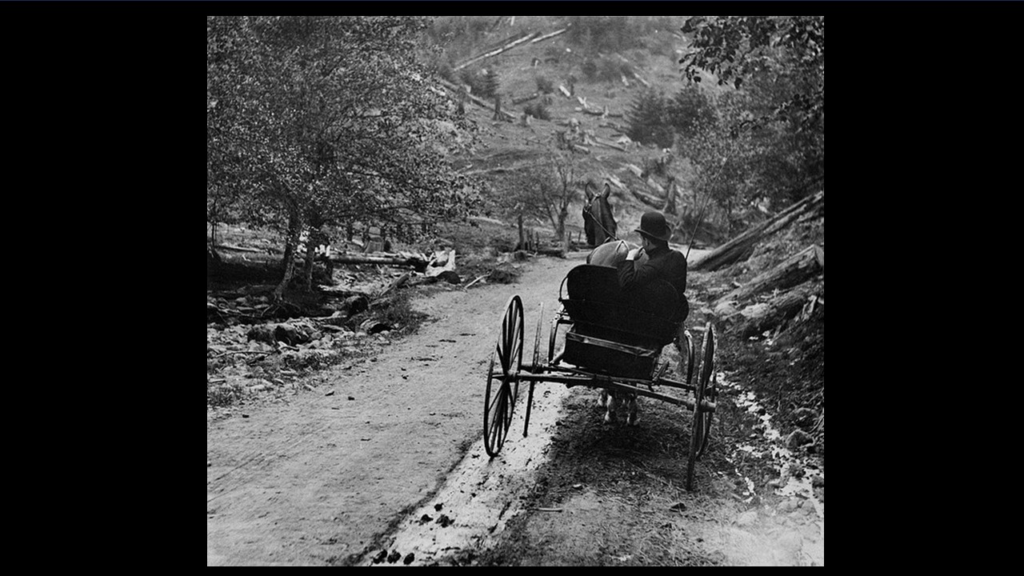
What Was the Great Plank Road?
The Great Plank Road was one of Portland, Oregon’s earliest major roads. Built in the 1850s, it connected the city to the rich farmland of the Tualatin Valley. Before this road, farmers had to use muddy, rocky paths that were hard to travel, especially in bad weather. The wooden plank road made it much easier to bring crops and goods into Portland, helping the city grow.
How Was It Built?
The road was made from large wooden planks—each about eight feet long and three inches thick. Workers laid these planks across wooden beams called stringers, creating a flat surface for wagons. The road was wide enough for one wagon at a time, with extra dirt paths on the side for passing. Construction began in 1851, and the first planks were laid during a big celebration that included speeches, a roasted ox, and even a gold coin buried under the first plank. Tolls were charged to use the road. At one point, to try to make the wagons travel faster, animal fat was rubbed on the planks. This had an unfortunate effect: it caused bears to come down from the forest to lick the animal fat.
Why Did It Matter?
The Great Plank Road helped Portland become a major city. When settlers arrived in the mid-1800s and gold was discovered in California, the Willamette River became a lifeline for the new community. Early Portland grew up along its west bank because ships could reach it from the Pacific Ocean through the Columbia River. Steamboats traveled up and down the river carrying supplies, lumber, and farm goods. The river made it possible for Portland to become a major port and trading center, connecting the inland farms of the Willamette Valley via the Great Plank Road to markets around the world. Farmers could now transport more goods faster, which boosted trade. It also helped Portland compete with other towns and grow into a busy port city. However, the wooden planks didn’t last long—they rotted and broke down after just a few years. Still, the road showed how important transportation was to building a strong community. The route of the Great Plank Road follows today’s Canyon Road.
_________________________________________________________
Discussion Questions
Why was the Great Plank Road important for Portland’s growth?
What problems did farmers face before the road was built?
Why do you think the road didn’t last very long?
How do you think transportation affects cities today?
Vocabulary
Plank Road: A road made from wooden boards.
Stringers: Long beams that support the planks.
Tualatin Valley: A farming area west of Portland.
__________________________________________________________
State Education Standards:
Social Studies 3.11. Describe how individuals, groups, events, and developments have shaped the communities and regions. Historical Knowledge
Social Studies 3.12. Compare and contrast the history of the local community to other communities in the region. Historical Knowledge
Social Studies 3.13. Apply research skills and technologies to gather information about the past in a region. Historical Thinking
,
-
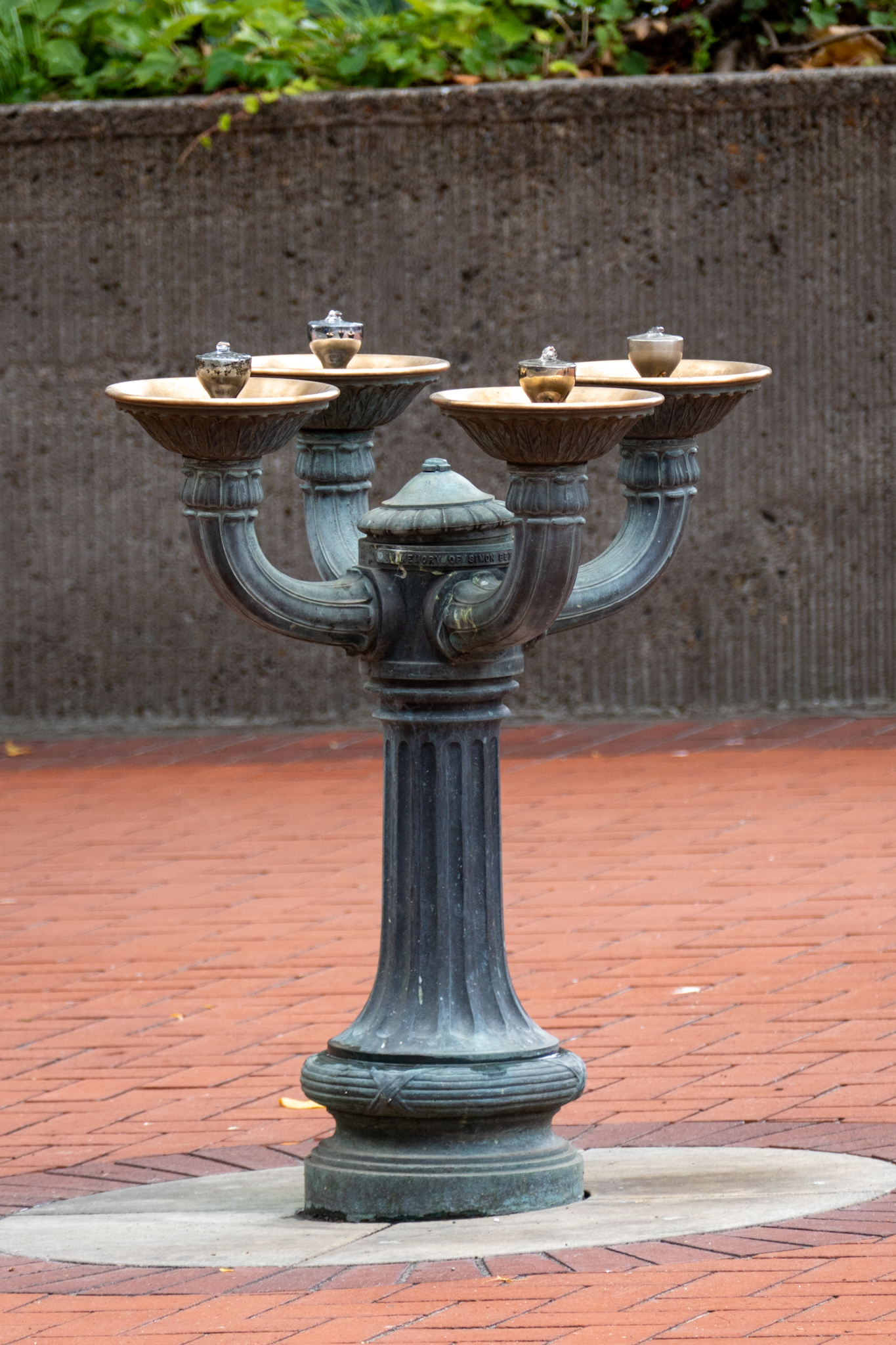
Benson Bubbler – 1912
The Benson Bubblers are iconic four-bowl bronze drinking fountains found throughout downtown Portland, Oregon. They have become one of the city’s most recognizable symbols of civic pride and public generosity.
The Gift of Simon Benson
The fountains were donated to the city in 1912 by Simon Benson, an immigrant from Norway who came to this country at the age of 16. He became a successful businessman and philanthropist who cared deeply about the welfare of Portland’s people. Over time, two stories have been told about why Benson decided to give the city its famous drinking fountains:
- He was moved after seeing a thirsty young girl crying during a Fourth of July parade. Moved by her situation, he promised that no one in Portland should ever go thirsty again.
- Benson went into a saloon and asked for a drink of water. The saloon refused to give him water unless he bought a beer. He bought the beer, poured it on the floor, and drank the water!
Whether one story or both are true, they show Benson’s compassion and his belief that small acts of generosity can make a lasting difference.
In 1912 he donated $10,000 to fund the design and installation of public drinking fountains. Architect A.E. Doyle was commissioned to design the 20 fountains.
A Portland Icon
When first installed, 20 fountains were placed throughout downtown Portland, mostly near busy streets and workplaces. Currently, the Portland Water Bureau maintains 52 four-bowl Benson Bubbler fountains and 74 one-bowl variations throughout the city.
Despite their appearance, the single-bowl fountains are not Benson Bubblers. In fact, in the 1970s, the Benson family asked that the installation of the four-bowl fountains be limited to certain downtown boundaries so as not to diminish their uniqueness.
A few replicas have been placed in other locations — including one gifted to Portland’s sister city, Sapporo, Japan.
Legacy
More than a century later, the Benson Bubblers still flow daily, providing water to residents and visitors alike. Simon Benson’s gift continues to remind Portlanders of the power of kindness and community spirit.
Simon Benson also donated Multnomah Falls in the Columbia Gorge to Portland because of its lasting beauty. He also built the Benson Hotel and donated money to
build Benson High School. Simon Benson was known to have said “No one has the right to die and not leave something to the public and for the public good.”
________________________________________________________
Suggested Discussion:
Before the days when people carried water bottles with them, how would you get a drink of water?
Have you ever been thirsty and had a drink from a public water fountain?
Do you think he was a good citizen?
Vocabulary: philanthropist, bubbler
________________________________________________________
State Education Standards:
Social Studies 3.11. Describe how individuals, groups, events and developments have shaped the communities and regions. Multicultural Studies, Historical Knowledge
Social Studies 3.19 Analyze different ways that people, other living things, and the environment might be affected by an event, issue, or problem. Social Science AnalysiNote: For more information on the life of Simon Benson see the Biography section of the Guidebook.
,
- He was moved after seeing a thirsty young girl crying during a Fourth of July parade. Moved by her situation, he promised that no one in Portland should ever go thirsty again.