Guide Book Category: Early City Sites

  • Multnomah Hotel – 1912

    Embassy Suites   319 SW Pine St.

    Introduction

    Once known as the Grand Lady of Fourth Avenue, the Multnomah Hotel is one of Portland’s most famous and historic buildings. It has stood as a symbol of the city’s hospitality and growth since it first opened its doors in 1912.  At the time, it was one of the largest hotels in the Pacific Northwest, with over 700 guest rooms. The hotel’s grand size and elegant design showed how much Portland had grown since its early pioneer days. The building’s name honors the Indigenous Multnomah people who once lived in the region.

    The hotel’s structure is shaped like a giant “M,” allowing light and fresh air to reach many of the guest rooms. This design made the hotel both beautiful and practical for travelers in the early 1900s.

    A Place for Big Events

    During the early 1900s, the Multnomah Hotel became a center of activity and excitement. Presidents, movie stars, and world travelers stayed there, and it hosted community celebrations, dances, and meetings.

    One of the most memorable events happened shortly after the hotel opened. In 1912. Portland pilot Silas Christofferson made history by flying his Curtiss Pusher biplane off the roof of the Multnomah Hotel.  To accomplish this feat the plane was disassembled and carried in pieces to the roof where it was reassembled.  Christofferson lifted off in front of a cheering crowd and safely landed at nearby Vancouver, Washington.  The daring flight made national headlines and helped make both Christofferson and the Multnomah Hotel famous across the country.  A replica of Christofferson’s plane is on display in the hotel lobby.

    Changes Over Time

    As Portland changed, so did the Multnomah Hotel. After years of success, it closed in 1965, and the building was later used as office space. But its beautiful architecture and history were too important to lose. In the 1990s, it was restored and reopened as a hotel again.  It now has 275 rooms and provides private bathrooms for each room, something not available in 1912.   

    Today, it operates as part of the Embassy Suites by Hilton, but many of its original design details remain. Guests can still admire the ornate plaster ceilings, brass fixtures, elegant chandeliers, and the original post box that once carried guests’ letters through the hotel’s mail chute system. Sharp-eyed visitors can also spot the decorative “M” symbols built into the structure̶ an elegant reminder of the hotel’s proud name and history.

    ______________________________________

    Discussion Questions: 

    I’ve heard that “back in the day” ladies were not allowed to be on the main floor of the hotel unless they were escorted by a gentleman. They had to remain on the mezzanine level. How would we feel about that today?

    Point out architectural features on the columns and the dentil and egg and dart motifs in the ceiling.

    Vocabulary: dentil; egg and dart

    _______________________________________

    State Education Standards:

    Social Studies 3.17. Use a variety of historical sources including artifacts, pictures and documents to identify factual evidence. Social Science Analysis

    Visual Arts.10.CO1.3 Identify and show how artwork forms meanings, situations and/or culture (e.g. popular culture, online and local experiences) Connecting artistic ideas and works with societal, cultural and historical context, to deepen understanding.

    ,

  • Portland Flag

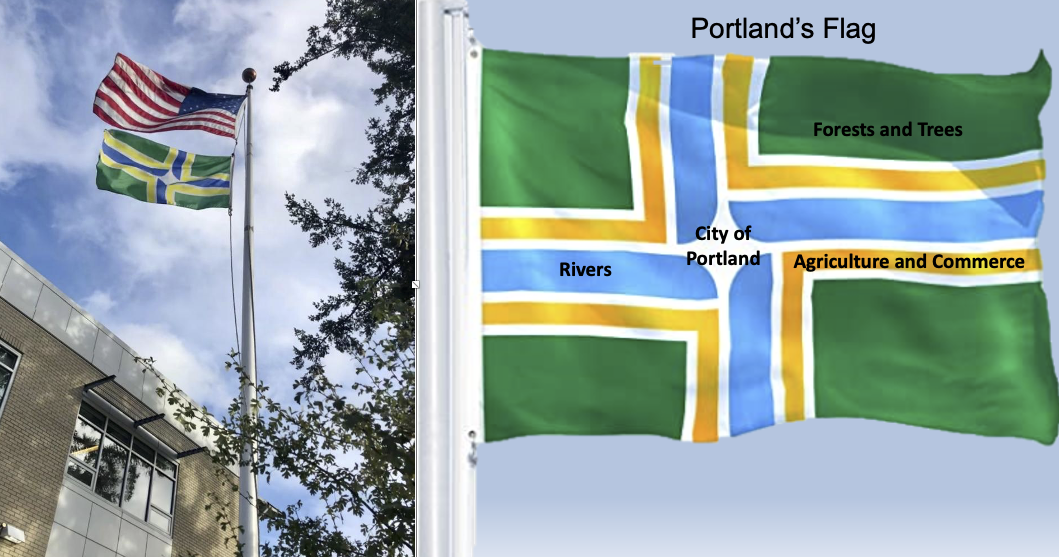
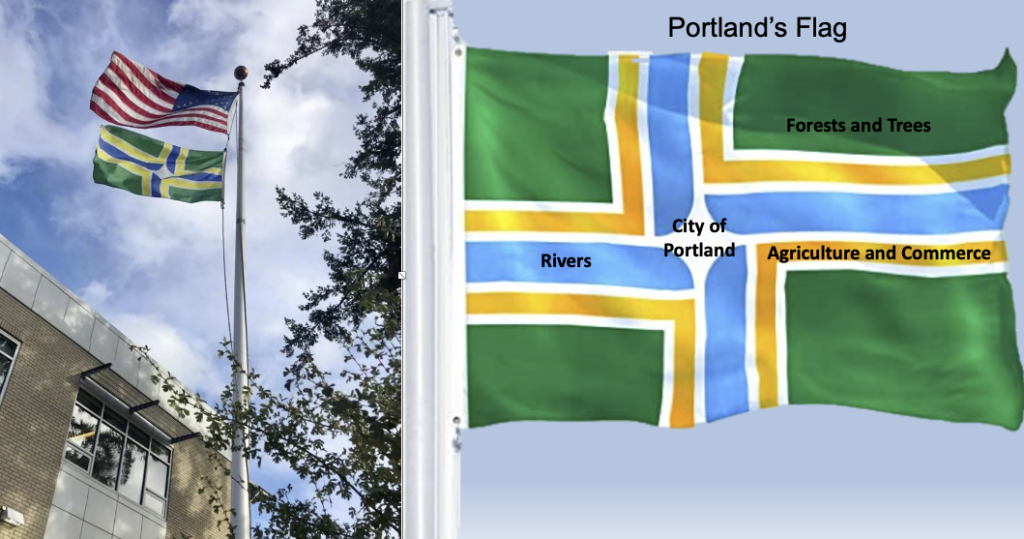
    The Portland flag, designed in 1969,  is a symbol that represents the city of Portland, Oregon. It features a green background with a white  star in the center and blue and yellow intersecting lines. Each part of the flag has a special meaning connected to the city.The blue lines represent the Willamette and Columbia Rivers that flow through Portland. The green background stands for the surrounding forests and the city’s parks. 

    The white star signifies Portland where the Willamette River and Columbia Rivers meet. 

    The yellow lines symbolize agriculture and commerce. 

    The flag reflects Portland’s identity and values as a river and forest city.

    ______________________________________________

    Discussion Questions:

    Why do cities use symbols like flags?
    How does the Portland flag show the city’s values?
    What symbols would you choose for a city flag?
    Why is nature important to Portland’s identity?

    Vocabulary Words

    Symbol – Something that represents an idea or place.
    Identity – What makes a place unique.
    River – A large natural stream of water.
    Design – The way something is planned or created.

    _______________________________________________________

    State Education Standards:

    Social Studies 3.11. Describe how individuals, groups, events, and developments have shaped the communities and regions. Historical Knowledge

    Social Studies 3.12. Compare and contrast the history of the local community to other communities in the region. Historical Knowledge

    Social Studies 3.14. Explain why individuals and groups in the same historical period differed in how they viewed and interpreted events. Historical Perspective

    ,

  • Ankeny Square

    SW Ankeny and 1st Ave

    Ankeny Square is a small but important public space in downtown Portland. It sits near the historic Skidmore Fountain and is part of Portland’s Old Town district. The square is named after Captain George H. Ankeny, one of the city’s early business leaders who helped develop nearby buildings, including the New Market Theater.

    In the early days of Portland, Ankeny Square was a lively meeting place. It was close to the Willamette River docks, where ships brought supplies and people to the city. Horse-drawn streetcars passed nearby, and the area was surrounded by cast-iron buildings, many of which still stand today as part of the Skidmore/Old Town Historic District.

    Today, Ankeny Square continues to celebrate Portland’s history. The city has placed cast-iron artifacts in the square to remind visitors of the old buildings that once filled the area. These pieces include decorative columns, arches, and other metal details that were saved from historic structures. They are displayed so people can see examples of the beautiful craftsmanship that made Portland famous for its cast-iron architecture in the mid-late1800s.
    Ankeny Square is a place where Portland’s past and present come together, reminding everyone how the city has grown while still honoring its roots.

    ____________________________________________________________________

    Discussion Questions:  

    How do we know the artifacts are cast iron?  

    Why would people save the artifacts?

    Why were the buildings built of cast iron instead of wood?

    Vocabulary: cast iron, craftsmanship, horse-drawn street cars, artifacts, architecture.

    __________________________________________________________________

    State Education Standards:

    Social Studies 3.11. Describe how individuals, groups, events and developments have shaped the communities and regions. Multicultural Studies, Historical Knowledge

    Social Studies 3.17. Use a variety of historical sources including artifacts, pictures and documents to identify factual evidence. Social Science Analysis

    Social Studies 3.19 Analyze different ways that people, other living things, and the environment might be affected by an event, issue, or problem. Social Science Analysis

    Visual Arts VA.5. PR2.3 Compare and contrast how art exhibited in and outside of school in museums, galleries, and other venues, including virtual spaces, contributes to the community. Presenting-Develop and refine artistic techniques and work for presentation.

    ,

  • Ascension – 1996

    55 SW Ash St.

    Completed in 1996 by Robert Calvo, Ascension at Fire Station 01 is a public sculpture of steel, brick, and glass symbolizing the bravery and daily heroism of firefighters. The piece uses vertical ladders and columns to represent the connection between firefighters and the buildings they protect.  The ladders symbolize their tools, their bravery, and the idea of striving upward toward goals. 

    The piece was funded by Portland’s “Percent for Art” program, which helps bring public art into community spaces, and it is part of the City of Portland and Multnomah County Public Art Collection. 

    Because it stands at a fire station, Ascension not only adds visual interest to the street but also honors the mission of the fire bureau. For people passing by, the sculpture encourages them to look upward and think about effort, safety, and community, showing how art can give meaning to everyday places.

    ______________________________________________________________________

    Discussion Questions :  

    How does this art make you feel?  

    Vocabulary: ascension

    ______________________________________________________________________

    State Education Standards: 

    Visual Arts.5.PR2.3 Compare and contrast how art exhibited in and outside of school in museums, galleries, and other venues, including virtual spaces, contributes to the community. Presenting-Develop and refine artistic techniques and work for presentation.

    Visual Arts..7.RE1.3 Distinguish between different types of art and determine messages communicated. Responding-Perceive and analyze artistic work.

    Visual Arts..8.RE2.3 Interpret art by identifying the mood suggested by a work of art and describing relevant subject matter and basic art elements. Responding-Interpret intent and meaning in artistic work

    ,

  • Bickel Block – 1883

    25 NW Naito Parkway

    The Bickel Block is a historic commercial building in Portland’s Old Town.  Being near the waterfront this neighborhood was once one of the busiest places in Portland.  Businesses wanted to be near the river so they could move products quickly.  The waterfront was packed with ships, businesses, workers, and warehouses. 

    Although originally commissioned by Frederick Bickel,  a candy-maker, the building’s first tenant was a machinery company that sold engines, boilers and other industrial equipment.  

    Unique Features

    One of the most noticeable things about the Bickel Block is its detailed exterior design, especially the windows and ornamentation. Look carefully, you will notice that the window styles change from floor to floor, which shows how the building was designed to be used. The first floor was built for storefront businesses and public access, so it typically had larger openings. The second floor windows were often made to look more impressive, since that level was commonly used for offices and important workspaces. Higher floors usually have simpler window designs, with less decoration, because they were more practical spaces.

    The building’s exterior also includes decorative architectural details meant to show craftsmanship and success. Around the windows and across the façade are decorative trim, repeating patterns, and scroll-like designs. These details helped the building stand out and gave it an image of stability and prosperity—important qualities for businesses in Portland’s growing downtown.

    Today, the Bickel Block remains an important part of Portland’s historic Old Town streetscape. It helps visitors imagine what this area once looked like during Portland’s early development, when detailed commercial buildings along the waterfront showed the confidence and growth of the young city.

    _____________________________________________________________________

    Discussion Questions:  

    What designs do you see on the building facade?

    Vocabulary: ornamentation, facade

    _________________________________________________________________________

    State Education Standards:

    Visual Arts.7.RE1.3 Distinguish between different types of art and determine messages communicated. Responding-Perceive and analyze artistic work.

    Visual Arts.8.RE2.3 Interpret art by identifying the mood suggested by a work of art and describing relevant subject matter and basic art elements. Responding-Interpret intent and meaning in artistic work

    Visual Arts 9.RE3.3 Use art vocabulary to express preferences about an artwork. Responding-Apply criteria to evaluate artistic work.

    ,

  • Bickel Building – 1883

    Dan & Louis Oyster Bar 

    208 SW Ankeny St

    The Bickel Building is named after Louis Bickel, a businessman who owned shops and rental properties in Portland.  Like many buildings in Old Town, the Bickel Building was made with brick and cast-iron details, which were very popular in Portland during the late 1800s.

    One of the most interesting things about the Bickel Building is how it was used over time. Many different businesses have occupied it, including small stores, offices, and restaurants. Today, the building is best known as the longtime home of Dan & Louis Oyster Bar, which opened in 1907. This makes it one of Portland’s oldest family-owned restaurants. 

    Inside the restaurant, visitors can see a cistern, which is a deep water storage tank built under the floor. Long ago, cisterns were important because they held water for fighting fires before modern plumbing and hydrants existed. In the Bickel Building, the cistern can still be viewed through a glass window in the floor, making it a unique feature.

    Architecturally, the building shows what early Portland looked like. It has tall, narrow windows, decorative trim, and metal details that were common in the 19th century. These cast-iron elements were made in local foundries, which helped Portland become known for its ironwork. Buildings like the Bickel help preserve the character of Old Town and help people understand what the city looked like more than a century ago.

    It is interesting to note how narrow SW Ankeny is.    This is because it was historically the dividing line between two early land claims and one of the property owners failed to dedicate their portion of land for the full street width.  Captain Ankeny set aside a 30-foot wide strip on his land claim to provide half of a standard street. 

    Captain Stark, was expected to do the same on his side. However, before he could, he was appointed to the U.S. Senate in 1861 and moved to Washington D.C., where he evidently forgot about the commitment.

    As a result, only half of the intended street width was initially built, and developers on the Stark claim built their properties right up to the edge of the narrow path, creating a permanent alley-like dimension. 

    Today this narrow street is a pedestrian only right-of-way and adds to the historic character of the area.

    _____________________________________________________________________

    Discussion Questions:

    Why were cisterns important to early Portland ?

    How does the narrow street make you feel?

    Would it feel differently if cars were allowed on it?

    Vocabulary:  cistern, pedestrian

    ______________________________________________________________________

    State Education Standards: 

    Visual Arts.5.PR2.3 Compare and contrast how art exhibited in and outside of school in museums, galleries, and other venues, including virtual spaces, contributes to the community. Presenting-Develop and refine artistic techniques and work for presentation.

    Social Studies 3.2. Describe the responsibilities of people in their community and state. Civics and Government

    Social Studies 3.17. Use a variety of historical sources including artifacts, pictures and documents to identify factual evidence. Social Science Analysis

    Social Studies 3.19 Analyze different ways that people, other living things, and the environment might be affected by an event, issue, or problem. Social Science Analysis

    ,

  • Blagen Block – 1888

    30-34 N.W. First Ave

    The Blagen Block is a historic building in Portland’s Skidmore Old Town HIstoric District. It was built in 1888 and is named after George Blagen, a businessman who owned lumber mills in Oregon.

    The Blagen Block was designed in the Italianate style, which was popular in the late 1800s. This style often includes tall, narrow windows and decorative details made of cast iron. The building is made of brick and has a cast iron facade.  The front of the building has an impressive 100 feet of cast-iron columns and arches.  There are fancy decorations like acanthus leaves, stars & stripes, arrows, laurel leaves and even lions heads.  Be sure to look for the Lady Liberty heads. Windows on each of the 3 floors are of a slightly different style.

    Over the years, the Blagen Block has been used for many different purposes, including offices and shops. In 2026, the building was purchased by Feed the Mass, a non-profit that provides meals and services to the unhoused.  They will operate a grocery store, event space, and incubator on the first two floors.  The building is now referred to as Nourish.

    ___________________________________________________________________________

    Discussion Questions:  

    What do you notice when you look at the Blagen Block? Shapes, Colors, Windows, Decorations?

    Imagine what kind of store or business might be inside this Blagen Block.

    Why is it important to keep old buildings instead of tearing them down?

    Vocabulary: Facade, cast-iron, column, arch, Italianate, Historic Landmark and renovation

    ___________________________________________________________________________

    State Education Standards:

    Social Studies 3.11. Describe how individuals, groups, events, and developments have shaped the communities and regions. Historical Knowledge

    Social Studies 3.12. Compare and contrast the history of the local community to other communities in the region. Historical Knowledge

    Social Studies 3.17. Use a variety of historical sources (artifacts, pictures, documents) to identify factual evidence. Historical Thinking

    ,

  • Bronze Plaques – 2005-06

    NW 3rd and 4th, between Burnside and Flanders

    There are 20 Bronze plaques embedded in sidewalks along NW 3rd and 4th Streets in the Old Town/New Chinatown neighborhood.  The plaques were created as part of a streetscape Public-Art Project and installed in 2005-2006 to celebrate the neighborhood’s history and cultural life.  The plaques use a garden theme, designed by Portland Urban Designer, Suenn Ho.

    Each plaque is a heavy cast-bronze piece set prominently into the sidewalk so as to be easily seen.   They honor the many cultures and ethnic groups, important people and places, and share historical facts. The plaques help tell the story of our city and remind us that many different types of people have lived here.. Because they are made from a mixture of copper and tin (bronze) they are long lasting  and can handle the city’s rainy climate.  They serve as reminders of the city’s past and help residents and visitors learn more about local history.

    Link to map of plaque locations

    _____________________________________________________________________________

    Discussion Questions:

    Did any plaque remind you of a plant, food or story from home?

    Choose a plaque and tell a friend about it.

    Can you link a plaque to local history, immigration, neighborhood business, or garden?

    Vocabulary:  plaque, streetscape, designer, bronze, culture

    ____________________________________________________________________________

    State Education Standards:

    Social Studies 3.11. Describe how individuals, groups, events, and developments have shaped the communities and regions. Multicultural Studies, Historical Knowledge

    Social Studies 3.12. Compare and contrast the history of the local community to other communities in the region. Historical Knowledge

    Social Studies 3.17. Use a variety of historical sources (artifacts, pictures, documents) to identify factual evidence. Historical Thinking

    VA:Re8.1.3a. Interpret art by referring to contextual information and analyzing subject matter, form, and materials. Visual Arts Responding

    ,

  • Chinatown Lantern Project – 2024

    NW 3rd Ave, between Couch and Davis

    In 2024, Portland’s Old Town Chinatown neighborhood added a colorful display of overhead lanterns.  This is part of a community project to celebrate the area’s cultural history and make the streets feel more welcoming. Organized by local community groups, the project brought beauty, light, and positive activity to a historic neighborhood that has faced challenges in recent years. By highlighting traditions from Asian cultures, the lanterns help visitors see Chinatown as an important and lively part of Portland’s past and present.

    The display includes 80 Chinese and Japanese lanterns. Chinese lanterns are round with gold tassels.  The red color represents  luck and happiness. The Japanese lanterns are a simpler shape, tall or box-shaped. Together, the different lantern styles create a street display that is both cheerful and peaceful, showing the rich cultural traditions connected to Portland’s Chinatown.

    ________________________________________________________________________

    Discussion Questions:

    Why do you think the community wanted to add lanterns to Chinatown?

    How can lighting make a place feel safer?

    How can community projects bring people together?

    Vocabulary: culture. lanterns

    ________________________________________________________________________

    State Education Standards:

    Social Studies 3.11. Describe how individuals, groups, events and developments have shaped the communities and regions. Multicultural Studies, Historical Knowledge

    ,

  • Chinatown and Chinatown Gate

    SW 4th Ave and West Burnside

    The original Portland Chinatown was south of West Burnside, around SW 2nd and 1st Ave.  Eventually due to fires, floods, economic and political changes, the Chinese community was forced to relocate north of West Burnside to what is today considered Chinatown.   

    Chinese immigrants started coming to Portland in the early 1800’s, especially after the California Gold Rush.  Many of these early Chinese people came to work on the railroads, others worked in mining, or in boarding houses, laundries, restaurants and other labor jobs.  In 1882, the Chinese Exclusion Act was passed by the U.S. Congress which made it much harder for Chinese laborers to immigrate.   The Chinese population declined dramatically however, China Town remained a vibrant community.

    The Chinatown Gate 

    The Chinatown Gate is hard to miss. It is tall—about as high as a three- or four-story building—and built like a traditional Chinese ceremonial entrance. The Gate has:

    • Bright red columns (posts) that support the structure
    • Layered roof with upturned corners, common in Chinese architecture
    • Lots of detailed decoration in green, gold, blue, and red
    • 78 dragons on the roof and along the top
    • Most China Gates have 5, 7 or 9 roofs, as these numbers bring luck.

    In Chinese culture, dragons are powerful symbols. They often represent strength, good luck, and protection. Seeing so many dragons on the Gate helps show that this place is special and important.  The color red is the symbol of happiness, vitality, prosperity and celebration.

    The Chinatown Gate was built in 1986 as a way to celebrate and strengthen the Chinatown neighborhood..  The gate, called a Paifang, with its 2 red columns is a gesture of Good Will.  The front side says, Welcome to Chinatown.  The other side says; 4 Seas, 1 Family.  

    At the base of the gate are 2 Foo dogs which are symbolic statues to protect Chinatown from evil spirits and harm.  Together they symbolize the balance of yin and yang. The male clutches a money ball under his paw to symbolize control over the material world, while the female cradles a cub, representing nurturing and protection of the home. Traditionally, the male Foo dog is always on the right side of the gate and the female is on the left.

    Time Capsule 

    A plaque in the ground near the gate marks where a Time Capsule was buried when the Gate was officially dedicated on February 14,1987.  A time capsule is like a message to the future. It contains memorabilia, meaning special keepsakes chosen to represent Chinatown and the people who lived and worked here.  The capsule will be opened 100 years after it was buried.

    _____________________________________________________________________________

    Discussion Questions:

    How old will you be when the Time Capsule is opened in 2087?

    What things do you think are in the time capsule?

    If you buried a time capsule today, what one object would you include to represent Portland – and why?

    What  challenges did  the Chinese community face in the late 1800’s?

    Why is the China Gate important today?

    Vocabulary:  Memorabilia, Immigrant,, exclusion, , Paifang, 

    ____________________________________________________________________________

    State Education Standards:

    Social Studies 3.11. Describe how individuals, groups, events and developments have shaped the communities and regions. Multicultural Studies, Historical Knowledge

    Social Studies 3.17. Use a variety of historical sources including artifacts, pictures and documents to identify factual evidence. Social Science Analysis

    Visual Arts.5.PR2.3 Compare and contrast how art exhibited in and outside of school in museums, galleries, and other venues, including virtual spaces, contributes to the community. Presenting-Develop and refine artistic techniques and work for presentation.

    Visual Arts.10.CO1.3 Identify and show how artwork forms meanings, situations and/or culture (e.g. popular culture, online and local experiences) Connecting artistic ideas and works with societal, cultural and historical context, to deepen understanding.

    ,

  • Delschneider Building  – 1859

    71 SW Oak Street

    The Dielschneider Building is the third oldest brick commercial building in Portland.   

    Originally, it had two stories, and later a third story was added in 1876.  The main features are the narrow, rectangular windows on the upper floors and larger display windows at the street level.   It was first used by the Novelty Iron and Brass Works factory, which shows how buildings long ago had different uses than today.    Factories today are not in fancy buildings in the heart of the city.  

    _____________________________________________________________________________

    Discussion Questions

    Notice the fire escape on the outside of the building.  Why did buildings have exterior fire escapes?

    Look for other buildings with fire escapes.

    Vocabulary: Fire escape 

    ______________________________________________________________________________

    State Education Standards:

    Visual Arts.7.RE1.3 Distinguish between different types of art and determine messages communicated. Responding-Perceive and analyze artistic work.

    ,

  • Fechheimer & White Building- 1885

    233 SW Front Street

    The Fechheimer & White Building is one of the best preserved of Portland cast iron buildings. The building was constructed around 1885, although some sources also give the year as 1870.

    The quality of the cast-iron work is excellent.  It was cast by the Willamette Iron and Steel Company and is a delightful example of a cast iron building which has been well maintained and carefully restored.  The entrance steps are granite rather than cast iron. 

    A Willamette Iron Works maker plate appears on the column to the right. 

    Renovation and Use

    The building underwent extensive renovation that included seismic upgrades, interior improvements, new doors and hardware, and reconfigured office spaces on upper floors.   Over time the building has been used for offices, a clothing store, warehousing and a drug store.  It is a piece of history showing how Portland’s commercial districts looked in the 1800’s. 

    When you walk by it, you’re seeing a building that has stood for well over140 years, survived many changes, and continues to tell a story.

    ____________________________________________________________________________

    Discussion Questions:

    Can you imagine the whole street being lined with buildings like this?

    Vocabulary:

    Seismic upgrade – reinforcing a buildings foundation, walls, roof and chimney to resist earthquake shaking

    _____________________________________________________________________________

    State Education Standards:

    VA.7.RE1.3 Distinguish between different types of art and determine messages communicated. Responding-Perceive and analyze artistic work.

    Social Studies 3.11. Describe how individuals, groups, events, and developments have shaped the communities and regions. Historical Knowledge

    Social Studies 3.12. Compare and contrast the history of the local community to other communities in the region. Historical Knowledge

    Social Studies 3.13. Apply research skills and technologies to gather information about the past in a region. Historical Thinking

    Social Studies 3.17. Use a variety of historical sources (artifacts, pictures, documents) to identify factual evidence. Historical Thinking

    ,

  • Fire Museum

    Portland Fire and Rescue Station 1

    SW Naito Parkway

    The Jeff Morris Memorial and Neal Heesacker Fire Museum is located in Fire  and Rescue Station 1.   The entrance is on Naito Parkway.   Morris and Heesacker were highly regarded Public Information Officers who put on safety displays at schools and other public events. The Museum was created in 2018, with private money, labor, material, and donations from the public and local businesses.  The contents and apparatus are original Portland pieces.

    The theme of the museum is apparatus: Hand Pulled, Horse Drawn and Motorized.  Some pieces of equipment are restored and others are in original condition.  Everything, except the Hose Wagon, are original Portland pieces from 1850-1918.  

    Please remind students that there is no climbing on equipment or ladders and no touching the displays.

    Museum Highlights:

    Motorized – The first motorized equipment was a car for the Fire Chief.  Next  addition was  a frame with motor and steering to the steam pumper.   A short time later fully motorized vehicles became available.

    Fire Box – Citizens would break the glass to pull a lever to sound the alarm. The boxes were located throughout the city. Each had a number which coincided with its location. This informed the fire department of where the alarm was pulled and where the fire was.

    Life Net –  The Life Net needed 8-12 people to catch a jumper. This is a large round canvas device with handles along the edge. Volunteers would hold the net to catch people who had to jump from upper stories of a building. 

    Watchdesk – There was a watchdesk in every station. It had alarge bell above on the wall. When the alarm went off, the bells would clang, the lights came on, the doors went up. 

    Access is only by pre-arrangement through the Fire Department Public Education Office

    Contact Info as of March 2026::

    Kim Kosmas, Senior Public Education Officer

    Portland Fire and Rescue

    kim.Kosmas@portlandoregon.gov

    503-793-6035

    Copy Belmont Fire Station on all email correspondence: belmontfire@portlandoregon.gov

    ___________________________________________________________________________

    Suggested Discussion:  

    How has fire fighting changed and improved? 

    Firefighters do more than respond to fires. What else do they do?

    Vocabulary: apparatus, memorial, watchdesk, volunteer, motorized

    ____________________________________________________________________________

    State Education Standards:

    Social Studies 3.1 Examine how different levels of city and county government provide services to members of a community. Civics and Government

    Social Studies 3.2. Describe the responsibilities of people in their community and state. Civics and Government

    Social Studies 3.11. Describe how individuals, groups, events and developments have shaped the communities and regions. Multicultural Studies, Historical Knowledge

    ,

  • Floods – Their Impact of Early on Portland


    From its earliest days, Portland has lived closely with the Willamette and Columbia Rivers—the waterways that made it a center for trade and shipping in the 1800s.   Yet those same rivers also brought devastating floods that reshaped the city’s growth, economy, and communities.

    Early Flooding and Its Effects
    Before modern flood control systems were built, Portland was regularly hit by floods that covered parts of downtown and nearby neighborhoods.   The 1894 flood was one of the worst disasters in the city’s history, when the Willamette River rose more than 33 feet above flood stage, turning downtown streets into canals.  Steamboats tied up to buildings, and many businesses were lost.

    These repeated floods caused enormous damage to Portland’s early riverfront district—especially along Front Street (Naito Parkway today), then the city’s main commercial center.  Merchants and residents began to abandon these low-lying areas, moving westward to higher ground. This shift reshaped Portland’s layout, pushing development toward the hills and away from the river’s edge.

    Displacement and Change
    The flooding and westward movement also affected Portland’s Chinese community, which had settled near the waterfront in what was then known as Chinatown.  Many Chinese immigrants lived and worked in basements and ground-floor buildings that were hit hardest by the rising water.   Repeated flooding, combined with discriminatory city policies, forced much of the community to relocate.   Over time, Portland’s Chinatown moved farther north, leaving behind an area that had once been a center of immigrant life and culture.

    Responses and Modern Improvements
    After the 1894 flood, city leaders took action to prevent future disasters. Streets were raised, sewer systems improved, and new buildings constructed with higher foundations.  In the 1920s, the city also built a sea wall along the Willamette River in downtown Portland to help protect the area from future flooding.

    Later, the creation of Tom McCall Waterfront Park in the 1970s transformed former flood-prone land into a public space that celebrates the city’s connection to the river—without the danger that once came with it.

    Recreation Returns to the River

    For many years the river was neglected.  Industry and development dumped waste and sewage into the river making it unsafe for swimming.  Today, thanks to the efforts of many to clean up the river it is once again safe to swim in.  A number of beaches have been cleaned to allow for easier access to the river.  

    ________________________________________________________________________

    Discussion Questions: 

    What happened to the old docks that were along the river before the sea wall was constructed?

    Why is it important to have access to the river for swimming?

    Vocabulary: Sea Wall, sewage

    ________________________________________________________________________

    State Education Standards:

    Social Studies 3.8. Identify and describe how people in the local community and region use natural resources. Geography

    Social Studies 3.9. Describe and explain how people in the community and region interact with the environment. Geography

    Social Studies 3.10. Explain how people have adapted to and modified the environment. Geography

    Science 3.3. Analyze and interpret data to describe typical weather conditions expected during a particular season. Earth and Space Science

    Science 3.4. Make a claim about the merit of a design solution that reduces the impacts of a weather-related hazard. Engineering Design

    ,

  • Gas Street Lights in Early Portland

    1860’s – 1890’s

    Before Portland had electric streetlights, the city used gas street lamps to light streets and sidewalks at night. In the mid-1800s, Portland’s streets could be very dark after sunset. People often carried lanterns or depended on moonlight. When gas streetlights arrived, they were one of the first signs that Portland was becoming a modern city.

    In June 1860, Portland began lighting some streets with gas lamps. The gas was made from coal (often called coal gas). This system was not easy to create in a young city so far from major factories. Some of the gas-making equipment had to be shipped a long distance—by sailing ship traveling around Cape Horn at the tip of South America.

    Gas streetlights were usually installed along the busiest downtown streets, where businesses and hotels were located. The lights helped people feel safer at night and made it easier for stores to stay open later. But these lamps were not automatic. In the early days, cities often hired lamplighters who walked from lamp to lamp each evening to light them, then returned later to turn them off.

    By the early 1870s, gas street lighting had expanded, with reports that more than 100 gas lamps were in use on Portland streets. Over time, however, gas lighting was slowly replaced by electric lights. By the late 1800s, Portland was beginning to use electricity for lighting, including early power generated by Willamette Falls.

    Even though they are mostly gone today, gas streetlights helped Portland grow. They made the city brighter, safer, and more active at night—an important step toward the modern Portland we know now.

    Hint: Look for old gas street lights on the northeast corner of NW 1st and Couch.

    ______________________________________________________________________

    Discussion Questiions: how did the lamplighter reach the light so high up?

    Vocabulary: lamplighter, coal gas, Cape Horn

    ________________________________________________________________________

    State Education Standards:

    Social Studies 3.1 Examine how different levels of city and county government provide services to members of a community. Civics and Government

    Social Studies 3.10 Identify and analyze Oregon’s natural resources and describe how people in Oregon and other parts of the world use them. Geography

    ,

  • Glisan Building (Kell’s) – 1889

    112 SW. 2nd Ave.

    The Glisan Building was constructed in 1889 and was named after Dr. Rodney L. Glisan, who had his medical offices on the second floor. The ground floor was first used as a creamery, which is a business that processes milk, butter, and other dairy products. Over time, the building was used for many different businesses, which shows how downtown Portland changed through the years.

    The Glisan Building is special because it is considered one of the last cast iron buildings constructed in Portland. Its brick walls and decorative metalwork make it stand out on this street.

    As Portland developed, the building continued to serve new purposes. In the 1960s, it was home to Chown Electric Supply Company. Later, in the 1990s, it became known for Kells Irish Pub, a popular restaurant and gathering spot that helped keep the building active and well-used. Even after more than 130 years, the Glisan Building remains an important part of downtown life.  Its survival shows how historic buildings can continue to play a meaningful role in a modern city.

    ________________________________________________________________________

    Discussion Questions:

    There are 2 metal rings on the curb in front of the building. Ask the students what they think they were used for – a place to tie up horses.

    Have you seen these rings anywhere else? In your nieghborhood?

    Vocabulary: creamery

    _______________________________________________________________________

    State Education Standards:

    Social Studies 3.17. Use a variety of historical sources including artifacts, pictures and documents to identify factual evidence. Social Science Analysis

    Visual Arts.5.PR2.3 Compare and contrast how art exhibited in and outside of school in museums, galleries, and other venues, including virtual spaces, contributes to the community. Presenting-Develop and refine artistic techniques and work for presentation.

    Visual Arts.7.RE1.3 Distinguish between different types of art and determine messages communicated. Responding-Perceive and analyze artistic work.

    ,

  • Hallock McMillan Bldg. – 1857

    237 SW Naito Parkway

    The Hallock-McMillan Building is one of the city’s most important historic structures. Built in 1857, it is the oldest surviving commercial building in Portland.

    A Building from Portlands Early Years

    In the 1850s, Portland was still a small town with dirt streets, wooden sidewalks, and businesses that served farmers, loggers, and ship crews. The Hallock-McMillan Building was one of the first to use brick and cast iron, making it stronger and more fire-resistant than the wooden buildings around it. Its location on Front Avenue (now Naito Parkway) put it right in the heart of Portland’s first business district. The building was designed by Absalom Hallock, one of Portland’s first professional architects.

    Why Its Important

    The Hallock-McMillan Building represents a turning point in Portland’s architectural history. It was the first cast-iron‒fronted building in the city, starting a trend that spread through the downtown area for the next several decades. Soon, many nearby blocks were filled with other cast-iron buildings.  Portland is second only to New York City in the number of remaining historic cast iron buildings. .

    Restoration and Legacy

    Over the years, the building went through many changes and even suffered from neglect. In the 1940’s it was badly remodeled to be more”modern”.  Most of the cast iron details were removed and the exterior covered in plaster.  Thanks to the commitment by a local historical preservationist, John Russell, the building exterior has now been carefully restored to look much like it did in the 1850’s.

    Today, the Hallock-McMillan Building stands as a link between Portland’s past and present. It shows how architecture can tell a city’s story̶ and why preserving old buildings keeps that story alive.  The building has seen many different uses over time – candy factory, offices and longshoremen hiring hall.   What will it be next?

    _____________________________________________________________________________

    Discussion Questions:

    How does the renovated facade reflect the historic character of the neighborhood?

    Is John Russel a “Good Citizen”?

    Vocabulary: facade, architect, plaster, longshoreman

    _____________________________________________________________________________

    State Education Standards:

    Social Studies 3.3. Explain how a community relies on active civic participation and identify opportunities for student participation in local and regional issues. Civics and Government, Multicultural Studies

    Social Studies 3.11. Describe how individuals, groups, events and developments have shaped the communities and regions. Multicultural Studies, Historical Knowledge

    Visual Arts .7.RE1.3 Distinguish between different types of art and determine messages communicated. Responding-Perceive and analyze artistic work.

    ,

  • Hazeltine Building – 1893 

    Floods – 1894 and 1948

    133 SW Second

    The Haseltine Building originally housed J. E. Haseltine & Co., a company that sold hardware, supplies, and wagon materials. The building was constructed during a time when Portland was growing quickly, and many new businesses were opening to support the needs of the developing city.

    The building’s exterior has a strong and sturdy appearance. The lower floors are made of heavy stone, while the upper floors are covered in stucco over brick. One of the most noticeable features is the series of large stone arches on the ground floor. These arches were popular in late 19th-century architecture and give the building a bold, almost fortress-like look.

    One of the most interesting things about the Haseltine Building is the flood markers on its outside walls. These markers show how high the water rose during major floods in Portland’s history. Two of the most important floods were in 1894 and 1948. The 1894 flood marker is placed surprisingly high on the wall, showing how serious that flood was. The water remained high for days but people adjusted by using canoes, and rowboats to travel through the city.  Shopkeepers raised shelves above the floodwaters and reopened for business.  Customers arrived to shop by boat.  Waterfront businesses sustained the most damage as their foundations shifted and interiors were water damaged.  Recovering from the floods was expensive and took a long time.  

    The 1948 flood was the result of a break in a dike along the Columbia River.  The flood wiped out the community of Vanport in North Portland and left 18,000 people homeless.   The water level was not as high but it reminds us how the Columbia and Willamette rivers have shaped the city.

    Today, the Haseltine Building is still used for retail, offices and businesses, and many of its historic architectural features have been carefully preserved.  Visiting the building and seeing the flood markers helps people understand what earlier residents experienced and how the city has changed over time.

    _______________________________________________________________________

    Discussion Questions:  

    Have students measure their height against the marker.  Would their heads have been above water?

    Vocabulary: hardware, dike,

    State Education Standards: 

    Social Studies 3.17. Use a variety of historical sources including artifacts, pictures and documents to identify factual evidence. Social Science Analysis

    Social Studies 3.19 Analyze different ways that people, other living things, and the environment might be affected by an event, issue, or problem. Social Science Analysis

    Visual Arts 10.CO1.3 Identify and show how artwork forms meanings, situations and/or culture (e.g. popular culture, online and local experiences) Connecting artistic ideas and works with societal, cultural and historical context, to deepen understanding.

    ,

  • Horse Drawn Street Cars – 1872 – 1889

    Trolley Street  – SW First Ave.

    The story of Portland’s early horse-drawn streetcars begins in 1872, when the city was still small and most people walked wherever they needed to go. As businesses and houses spread out from the riverfront, walking became harder, especially in muddy winter weather. To solve this problem a local businessman built the city’s first horse-drawn streetcar line. The line ran along First Street through the downtown business district.

    The first route was only about two miles long.  The cars ran on iron rails set into the street and were pulled by one or two horses. Even though the cars were not very fast, they were more comfortable than walking in the mud and rain. 

    Fares were low enough that many workers could afford them, and the trolleys helped connect neighborhoods to the downtown area. Because the cars followed fixed rails, they were smoother and safer than regular wagons on rough streets. 

    However, horse-drawn streetcars had problems. Horses got tired, needed food and stables, and could not pull heavier cars very far or very fast.  By 1889 electric streetcars were introduced. These new electric streetcars were faster, cleaner, and cheaper to run.

    Even though they operated for only a few decades, Portland’s early horse-drawn streetcars were very important. They were the city’s first real public transit system and showed people that they did not have to live and work in the same small area. The lines encouraged new neighborhoods, helped businesses grow, and prepared the way for the larger network of electric streetcars that would come next. 

    Today, when modern streetcars run through downtown Portland, they are part of a long story that began with those small wooden cars, iron rails, and hard-working horses in 1872.

    Note:  Discuss horse drawn street cars anywhere along SW 1st and point out Max lines.   

    _______________________________________________________________________

    Discussion Questions:

    What were some problems with using horses to pull street cars?

    What “streetcar” runs along this street today?

    Vocabulary: fixed rails

    State Education Standards:

    Social Studies 3.1 Examine how different levels of city and county government provide services to members of a community. Civics and Government

    Social Studies 3.19 Analyze different ways that people, other living things, and the environment might be affected by an event, issue, or problem. Social Science Analysis

    ,

  • Packer Scott / Mercy Corp Building – 1890/ 2009

    SW 1st and Ankeny 

    The Packer Scott Building stands next to the Skidmore Fountain and has been part of the city’s waterfront for more than 130 years. It was built around 1890–1892 as a warehouse and at one time housed a fruit processing facility.   Later it was occupied by the Packer-Scott Company, which sold paper, twine, and janitorial supplies to businesses around the region. 

    By the early 2000s the building was worn out and needed major repairs, but it was also recognized as an important historic landmark. Mercy Corps, an international relief and development organization, chose the Packer Scott Building as the site for its new world headquarters. Instead of tearing it down, architects planned a project that would save the old structure and add new space next to it. In 2009 the building was seismically upgraded, restored to its original form, and connected to a new four‑story addition that seamlessly integrated the old building with the new, modern offices.  

    The building now represents both Portland’s past and its future. Its preserved brick walls and historic details remind visitors of the city’s early warehouse district, while the modern addition and sustainable design show how an old building can be adapted for new uses in a changing downtown.Mercy Corps vacated the building in 2025.

    ______________________________________________________________________

    Discussion Questions: 

    Can you tell where the new building joins the old building?

    Do you see any similarities in the designs of the old and new buildings?

    Vocabulary: seismic upgrade,

    ______________________________________________________________________

    State Education Standards: 

    Social Studies 3.11. Describe how individuals, groups, events, and developments have shaped the communities and regions. Historical Knowledge

    Social Studies 3.12. Compare and contrast the history of the local community to other communities in the region. Historical Knowledge

    Social Studies 3.13. Apply research skills and technologies to gather information about the past in a region. Historical Thinking

    ,

  • Phoenix Building – 1879 

    124 SW Ash Street

    The Phoenix Building is slightly deceiving today when we look at its exterior.   Like many buildings from the late 1880’s , it was constructed of cast iron in the Italianate style, with tall windows and brick walls that gave it a strong and elegant appearance.

    It was once the home of the Povey Brothers Art Glass Works, a famous stained-glass company sometimes called the “Tiffany of the Northwest.” The Povey Brothers created colorful glass windows for churches, homes, and public buildings all over Oregon and the Pacific Northwest. Their studio in the Phoenix Building was one of their earliest locations, and it helped shape Portland’s reputation for fine craftsmanship.

    Over time, the Phoenix Building went through changes that affected its appearance. In the 1950’s, the building was “modernized,” which means that new materials were added over the original front.   It was partially covered in gunite, a highly durable material that is almost impossible to remove, without damaging the surface of the building.  Much of the building’s cast-iron storefront on the ground floor is mostly hidden today. However, if you look closely you can still see clues of the older design in the shape of the windows, the layout of the few remaining cast-iron columns. 

    ________________________________________________________________________

    Discussion Questions:  

    Can you see the cast iron parts of the building ?

    Compare this building to the reconstructed Hallock McMillan Building. 

    Vocabulary: Modernization – adapting to more current needs and ideas

    ______________________________________________________________________

    State Education Standards

    Social Studies 3.13: Apply research skills and technologies to gather information about the past in a region.

    Social Studies 3.14. Explain why individuals and groups in the same historical period differed in how they viewed and interpreted events. Historical Perspective

    Social Studies 3.16. Identify how people and events of the past have influenced the present. Historical Knowledge

    Social Studies 3.17: Use a variety of historical sources including artifacts, pictures, and documents to identify factual evidence. (Note: Restoration efforts utilized vintage artifacts like prescription ledgers and medicine bottles).

    ,

  • Portland, Oregon Sign – 1940

    White Stag Sign

    The Portland, Oregon Sign is one of the most famous landmarks in the city. This large  neon sign is located on the west side of the Burnside Bridge and can be seen from downtown and the eastside of Portland. The sign shows the outline of the state of Oregon, with the words “Portland Oregon” written in bright white letters. On top of the sign, there’s a picture of a leaping white stag (a male deer) with a red nose that lights up during the holidays!

    The sign was first built in 1940.  At first, it said “White Satin Sugar” because it was an advertisement for a sugar company.  Later, it was changed to say “White Stag Sportswear,” another local company and the leaping stag was added.  In 1997, the words were changed again to say “Made in Oregon” the name of the company occupying the building where it is located. Finally, in 2010, the City of Portland took ownership of the sign and changed it to the words we see today: “Portland Oregon.”

    The sign lights up every night, and many people see it when crossing the Burnside Bridge. During the winter holidays, the stag’s nose glows red, just like Rudolph’s!  It’s an official city landmark, which means it’s protected and can’t be removed or changed without special permission.

    The Portland Oregon Sign is more than a piece of neon art – it’s a symbol of the city’s history and pride.  It represents Portland’s unique spirit and creativity.

    _____________________________________________________________________________

    Discussion Questions:  

    Why does the white stag sometimes have a red nose?

    How does seeing the sign make you feel?  Are you proud of your city?

    Who owns the sign today?

    Vocabulary: landmark, neon, iconic, advertisement, symbol, stag, restoration & design

    ___________________________________________________________________________

    State Education Standards:

    Social Studies 3.11. Describe how individuals, groups, events, and developments have shaped the communities and regions. Historical Knowledge

    Social Studies 3.12. Compare and contrast the history of the local community to other communities in the region. Historical Knowledge

    Social Studies 3.17. Use a variety of historical sources (artifacts, pictures, documents) to identify factual evidence. Historical Thinking

    VA:Re8.1.3a. Interpret art by referring to contextual information and analyzing subject matter, form, and materials. Visual Arts Responding

    ,

  • Railway Building – 1872

    112 SW 1st Avenue

    The Railway Building was built in 1872, when Portland was still growing along the Willamette River.  This structure is known as the Railway Building because it was connected to Portland’s early railroad activity. It was originally used to repair trains and heavy railroad equipment, and some of the old machinery used to lift engines is still inside today. Its high ceilings and large openings show that it was built for heavy work. 

    During the same time period, Portland’s first horse-drawn streetcars ran along SW 1st Avenue, right past the building, making the block an important transportation area. However, there is no clear evidence that streetcars were repaired inside the building.

    As Portland developed, the Railway Building was also used by commission merchants who handled produce, groceries, and other goods shipped into the city. A commission merchant was a person who sold products for farmers or suppliers and earned a fee from each sale. This kind of business was very common near the waterfront, where ships and trains delivered food and supplies.

    Over the years, the property underwent a number of changes. A section of the original building was removed in the 1950’s so that a parking lot could be built on the north side. Even though part of the structure was lost, important restoration work took place in the decades since to protect what remained.

    Today, the Railway Building is still in use and is home to creative offices and small businesses. Even though the city has changed around it, the building remains an important reminder of Portland’s early railroad history and the busy transportation routes that once passed right by its doors.

    ___________________________________________

    Suggested Discussion: Why did people want more parking lots?

    Vocabulary:  Transportation, street car

    ____________________________________________________

    State Education Standards: 

    Social Studies 3.11. Describe how individuals, groups, events, and developments have shaped the communities and regions. Historical Knowledge

    Social Studies 3.12. Compare and contrast the history of the local community to other communities in the region. Historical Knowledge

    Social Studies 3.13. Apply research skills and technologies to gather information about the past in a region. Historical Thinking

    Social Studies 3.17. Use a variety of historical sources (artifacts, pictures, documents) to identify factual evidence. Historical Thinking

    ,

  • Simon Building Facade 

    107 NW 3rd Ave.

    Between Couch and Davis

    The Simon Building Façade is like a historic snapshot: a bold, old-style front of a building from 1892 that has been preserved even though the rest of the building is gone. It reminds us how buildings can change, yet parts of them can stay and tell a story about the city’s past.At some point the building was mostly destroyed by a fire.  Only the front façade (the “face” of the building) remains and stands as a kind of “ghost” of the old structure

    There is an interesting story to how the facade was saved: The Naito brothers purchased the burned out building to make a parking lot for the building they owned next door, which was occupied by the Couch Street Fish House, a very popular expensive restaurant.  They planned to move the restaurant entrance to where the burned Simon Bldg. had been and make the vacant building site a parking lot.   

    One day a local architect, Bing Sheldon, noticed workmen intending to bulldoze the burned building.  He rushed to Naito’s office and told him it would violate city code.  Bill gave him 24 hrs. to come up with an alternative.   Sheldon suggested preserving the facade by shoring it up and placing the parking lot behind it.  Initially reluctant to pay the cost, Bill was persuaded when told that no one had ever done anything like it before.  

    It is the first known restoration of a building facade strictly for ornamental use in America.   The facade received recognition from the American Institute of Architects (AIA) for the preservation work.

    ________________________________________________________

    Suggested Discussion:  

    Is having the facade standing better than tearing the whole thing down?  Why?

    Vocabulary: facade, arches, architect 

    ________________________________________________________

    State Standards:

    Social Studies 3.11. Describe how individuals, groups, events, and developments have shaped the communities and regions. Historical Knowledge

    Social Studies 3.12. Compare and contrast the history of the local community to other communities in the region. Historical Knowledge

    Social Studies 3.17. Use a variety of historical sources (artifacts, pictures, documents) to identify factual evidence. Historical Thinking

    VA:Re8.1.3a. Interpret art by referring to contextual information and analyzing subject matter, form, and materials. Visual Arts Responding

    Story Source: Portland’s Audacious Champion by Eric Naito-Campbell

    ,

  • Skidmore Fountain – Historical Perspective

    by Charles Erskine Scott Wood 

    [This article appeared in The Oregon Historical Quarterly, vol. 34, no. 2 (June 1933), pages 97-102, and was forwarded to me by Nedra Brill. I was delighted to find that a German brewer had offered to pipe his lager there, an offer declined (alas) by the city fathers. It probably would not have thrilled the dogs or horses of Portland, but would certainly have pleased their masters. A definitive history of the fountain by Eugene E. Snyder called Skidmore’s Portland: His Fountain & Its Sculptor From Buckboards to Bustles, Binfords & Mort (1973), who suggests that free lager was only supposed to run on the day that the fountain was unveiled. For an account of Stephen Gregg Skidmore (1838-1883), the benefactor of Portland’s thirsty, see his father Andrew Reed Skidmore (family no. 245) in my Westerleigh book. (Warren Skidmore)] 

    I have been asked to give some account of how the Skidmore fountain came to be, and particularly how it came to be placed where it is now; and I am glad to place my recollections at the service of the Oregon Historical Society, but it must be understood that I am writing absolutely from memory, unrefreshed by any note or memorandum of any kind, and naturally there will be errors, and I do not pretend to know dates. 

    I resigned from the army and entered the practice of law at Portland, Oregon, in 1884; and eventually succeeded to the law business of Morris Fechheimer by association with his surviving partner, Henry Ach. This partnership was arranged by Fechheimer himself on his death bed, and Judge George H. Williams was invited to join us, which he did, and the firm of Williams, Ach and Wood was established in the former offices of Fechheimer and Ach in the First National Bank Building on the corner of First and Washington streets. I am giving these facts because from them I hazard the guess that it was sometime about 1887 (1) that one day as I was sitting in my office in the First National Bank Building I received a message from Henry Failing, in the bank below, requesting me to come to his private office, as he wished to speak to me on a matter of importance to him and to the city of Portland. When I called on him, he said to me, “I do not know that you are aware that Steve Skidmore left in his will a bequest of $5000 for the erection of a drinking fountain, to be placed in the business part of the city, for men, horses and dogs.” He then showed me the drawings of several designs of fountains from one or more marble or granite works making a business of doing this sort of thing, and he asked me what I thought of them. I looked at them, but told him without hesitation that they looked to me more like designs for soda 

    __________________________

    (1) In May, 1887, Mr. Wood received from the sculptor the agreement in regard to the price, style and date of completion of the fountain; Oregonian, May 25, 1887.  

    fountains in drug stores, and if one of them were put up, I felt sure, or at least I hoped, that the artistic taste of later generations would tear it down. He said I had expressed his ideas exactly and that was why he wanted to talk to me, and then continued, “Now, you know many of the best artists in New York,” and I said I knew Saint-Gaudens and Warner, and others, but I considered these as our best sculptors, and of course, I knew a lot of painters, such as J. Alden Weir, Ryder, Brush, and the architect Stanford White — and so on. “Well,” he continued, “I wish you would take up this matter for me, and write to the ones you think are the best, because I think in justice to Steve Skidmore and this youthful town we ought to begin with the very best, and I will have you appointed on the committee by the mayor.” 

    Of course I gladly accepted this trust, but I at once said to him, “Mr. Failing, it will be utterly impossible to have a civic fountain, such as I know you have in mind, for anything like $5000.” “Never mind about that,” he answered, of course Skidmore had no more idea that the rest of us about cost, but pay no attention to the amount of the bequest. just do the best you can, regardless of cost, for the present.” 

    I wrote to Augustus Saint-Gaudens and to Olin L. Warner. Saint-Gaudens said he was so far behind in important commissions that he did not dare undertake another, and thus eliminated himself from consideration. Warner wrote that he would gladly undertake it, but wanted some idea of the site where the fountain was to be placed, and the surroundings. Mr. Failing told me that the city was going to furnish the site and all the expenses of installation, and that the angle where First Street changes direction and where the fountain now stands had been selected. (2) Mr. Failing was quietly collecting a fund and Mr. Woodward, who was connected with a bank, said that if the fountain was placed at that particular site he would give a certain sum of money, considerable, but the exact amount I do not remember, and he made that condition because he was at that time the owner of a lot on First Street which was just opposite the fountain site. 

    Mr. Warner sent out two designs, one in a general way similar to the present fountain; but instead of two caryatides supporting the basin, and standing back to back, with a block of granite between, there were three caryatides and no central pillar, the three caryatides carrying the bronze basin. This, if I remember rightly, was about $35,000,

    _____________________________

    (2) The city vacated ground 23 feet in diameter at the intersection of First, Vine and Ankeny Streets. 

    the city or the Skidmore committee to bear the expenses of transportation and installation. The design for the fountain as it now exists was $18,000. Mr. Failing, Charles E. Sitton and a very few others quietly made up the $13,000 necessary to be added to the Skidmore bequest, and none of them would ever have a word said about it, and even I never knew how much Mr. Failing or any of them gave. They said they wanted it to be absolutely Steve Skidmore’s bequest with no thought of any other person associated with the gift. But though I do not know how much Mr. Woodward gave, I do know he gave a considerable amount, because it had that condition attached to it, and Mr. Failing told me of the gift and the condition. 

    After Mr. Warner had been engaged to do the work he was called west as far as Colorado, and he then came to Portland, for the express purpose of seeing the site and its surroundings, as he felt it important that he have the fountain in proper scale and harmony. At the time the United States Government was taking testimony to forfeit the land grant of the Willamette Valley, and Cascade Mountain Military Wagon Road Company, which had passed by purchase into the hands of Messrs. Lazard Freres. I, as their attorney and manager of the grant, went with the Government’s representatives, taking testimony at various points along the grant. This was in 1888. At Prineville, Oregon, my leg was broken, and while I was laid up there, I received from the Reverend Thomas L. Eliot a request for suggestions for the inscriptions to be cut into the faces of the lower granite basin of the fountain, and I sent down those which are now carved in the granite. An error was made by the stonecutter in some date relating to Steve Skidmore, whether it was birth or death, I do not know, but the error was filled in with concrete and recut, and the place may be seen if carefully examined. 

    I have been amused by the not infrequent references to that proverb which is on the fountain – “Good citizens arc the riches of a city” – as a quotation from the Bible – a compliment, of course, to the composer, but a reflection on the speaker’s or writer’s knowledge of the Book of Proverbs. 

    I was asked by Mr. Failing and the committee to make the address at the unveiling of the fountain, and the newspapers published this fact. (3) 

    _______________________________

    (3) The full text of Mr. Wood’s address is printed in the Oregonian, September 23, 1888. 

    Henry Weinhard, the brewer, as fine and honest an old German as you could find, and whose attorney I was, came to see me, as I supposed on legal business, and when we were alone he unbosomed himself of the proposition that he himself would bear the expense of whatever hose was necessary in addition to the fire hose of the city, to connect his largest lager tank with the fountain, and have the fountain spout free beer! 

    Of course I gratefully thanked him- perhaps not as gratefully as I might in these days – and conveyed the proposition to Mr. Failing, who felt obliged to decline it. 

    At the unveiling all of Portland’s great and near-great were present. W. S. Ladd sat in his buckboard right in front of me as speaker, and when I paid a tribute to the boy, Steve Skidmore, who in his last hour thought of the city which had received him penniless, and where he made his money, and spoke of the nature that could think of the down town busy part of the city, the sweaty drivers of trucks and drays, the thirsty horses and the thirsty little dogs, I saw tears trickling down Mr. Ladd’s face unchecked. 

    And so the Skidmore fountain came to be. 

    I understand that once more the epidemic to move the fountain is agitating certain members of the community. If I may be allowed to say so, this continual recurrence very seriously reflects on the artistic judgment and good taste of these people. At first blush it may seem natural to collect everything that a city has in the way of works of art in its park as a sort of cemetery or museum. But I think a little serious thought on the matter ought to show that the works of art decorating the public places of a city should remain where they were placed by the city and the citizens of their day, and instead of herding everything in a park, more things ought to be placed in the heart of the city, where the stream of human life flows longest and thickest. I cannot help thinking of the statues and fountains I saw in Rome, Naples, Venice and all the hill cities of Italy, rooted for centuries, in the places which were selected for them. One of the greatest fountains of the world, the Fountain of the Turtles, is down in a quarter of Rome whose elegance has passed for centuries, among beggar population and ragged little children, but the people never think of moving it. In the first place they are not so poor in works of art, and secondly they are more religious minded and know it would be desecration. The very greatest equestrian statue in the world is in a little, obscure, bare plaza in Venice. If a people’s instinct does not teach them to respect a work of art in its original place, to respect those who put it there, if they are actually so bourgeois and new-rich that they cannot bear to leave their one and only work of art where Steve Skidmore clearly willed it to be, where Henry Failing and those men who reverently carried out Skidmore’s will from their own pockets, wished it to be, where the sculptor placed it and came across the continent to view the site, that all might be harmonious, then move it. No skyscrapers can ever affect that harmony; it is not height of line around the Skidmore fountain that can ever affect it, but a widening of space, with trees for environment, would be simply ignorant vandalism. If the city fathers and a controlling element of the city wish to show their ignorance, I suggest that they put the Skidmore fountain on wheels, which might be done in these days of great truck wheels, and move it from place to place, as the mood changes, with a card “This is our one and only work of art, the world celebrated Skidmore fountain. Bids will be accepted for its next location.” 

    I do not like to stress the legal obligation existing, because Steve Skidmore gave his money specifically that dogs and work horses and thirsty laboring men might have drink; that Mr. Woodward contributed, and all the other gentlemen contributed heavily, to place that fountain just where it is, after careful consideration. If ever there is anybody interested enough to do so, he can bring court proceedings to stop this stupid misunderstanding of art, and works of art. 

    I have several times written on this subject at the request of various people, William S. Ladd, Miss Henrietta Failing, and others, and I am now writing for the last time and by request, placing the history of the fountain where it may be kept. I hope if this sort of “flu epidemic” ever gets dangerous, that some citizen of Portland will have civic pride enough to take the case into court, as he would have an absolute right to do. But no court decree would be as powerful as an educated good taste and an artistic righteousness in the people to determine that a monumental work of art, made as a very part of the city itself, should be left where the sculptor and the citizens of its own time originally placed it. If ever an ignorant generation without art instinct moves the fountain to the park, they will be surprised to see how it will shrink in importance and will become more insignificant. Or will they see? No. If they are dull enough to move it, they will be too dull to see what they have done. It will always be a great work of art, but it will be out of place, and will have lost its eternal fitness, which the most ignorant must now feel as they contemplate it. 

    And finally I suggest that the fountain might be used as a text to educate the children of the public schools in culture and good taste and art appreciation which will hold an architectural work of art at least as sacred as a tombstone in a cemetery. 

    ,

  • United Carriage and Baggage Transfer Building – 1886

    126 SW 2nd Ave.

    The United Carriage and Baggage Transfer Building was built during a time when the city relied on horses and wagons to move people and goods. The building was originally used by the United Carriage and Baggage Transfer Company, which helped transport luggage, packages, and travelers around Portland before the age of cars. Because of this, the building had large ground-floor openings so that horse-drawn carriages could easily enter and unload.

    The first floor was used for carriage storage and loading. The second floor held horse stalls and the third floor provided extra storage, work space and sleeping quarters for carriage operators.  On the roof were four massive tanks that provided water to wash the stalls. The building was essentially a parking garage for horses and carriages.    We call it the  “Horse Hotel”.

    Over the years, as transportation changed, the building was used by other companies, including businesses that sold wagons, machinery, and logging equipment.

    Today, the building has been completely renovated and adapted to modern uses. It has been restored and now houses the Pine Street Market, a popular food hall. Even with these modern changes, the building still keeps much of its original style, showing how historic structures can be reused in new and creative ways. The United Carriage and Baggage Transfer Building is an important reminder of Portland’s early transportation history and how the city has grown and changed over time.

    ________________________________________________________________________

    Discussion Questions: 

    Would this be a good place for farmers visiting the New Market Theater to stable their horses?

    Vocabulary: water tank, renovate, adapt

    ________________________________________________________________________

    State Education Standards:

    Social Studies 3.11. Describe how individuals, groups, events, and developments have shaped the communities and regions. Historical Knowledge

    Social Studies 3.12. Compare and contrast the history of the local community to other communities in the region. Historical Knowledge

    Social Studies 3.13. Apply research skills and technologies to gather information about the past in a region. Historical Thinking

    Social Studies 3.17. Use a variety of historical sources (artifacts, pictures, documents) to identify factual evidence. Historical Thinking

    ,

  • Smith Block – 1872

    111 SW Naito Pkwy

    The Smith Block was originally built as a row of warehouses and mercantile (business) buildings.  It is especially notable for its cast-iron facade of columns and decorative metalwork.   When built, the ground floor windows on the Naito Parkway (Front Avenue) side were folding doors so that goods could be loaded and unloaded easily.

    The second floor housed the city’s first stock exchange. During a renovation a blackboard with gold and wheat prices was found. A liquor merchant and druggist also occupied the building.  In recent times, it has been renovated, seismically upgraded and adapted for modern office and restaurant use.  

    The building once extended 300 feet on Naito Parkway (still does) and 300 feet on First. The NW corner of First and Ash was removed in 1955 for a parking lot.   The First Ave portion is known as the Railway Equipment Bldg. See section on Railway Equipment Bldg.

    The Smith Block is more than just an old building—it’s a piece of Portland’s story. It shows how the city’s commercial district grew during the 1870s, how buildings were designed using cast-iron to look impressive, and how preservation can keep history alive while adapting to modern needs. 

    ____________________________________________________________________________

    Discussion Questions: 

    Are all the columns cast iron?  

    Why do you think some columns are not cast iron?

    Vocabulary:  

    Facade

    ____________________________________________________________________________

    State Education Standards: 

    Social Studies 3.11. Describe how individuals, groups, events, and developments have shaped the communities and regions. Historical Knowledge

    Social Studies 3.12. Compare and contrast the history of the local community to other communities in the region. Historical Knowledge

    Social Studies 3.16. Identify how people and events of the past have influenced the present. Historical Knowledge

    Social Studies 3.17. Use a variety of historical sources (artifacts, pictures, documents) to identify factual evidence. Historical Thinking

    VA:Re7.1.3a. Speculate about processes an artist used to create a work of art. Visual Arts Responding

    VA:Re8.1.3a. Interpret art by referring to contextual information and analyzing subject matter, form, and materials. Visual Arts Responding

    VA:Cn11.1.3a. Recognize that responses to art change depending on knowledge of the time and place in which it was made. Visual Arts Connecting

    VA:Pr4.1.3a. Select and describe works of art, explaining why they are chosen for presentation. Visual Arts Presenting

    ,

  • Society Hotel – Mariners Building – 1881     

    Society Hotel – Mariners Building – 1881                 

    Originally, the building was only three stories tall.  However, in 1891, 10 years after its initial construction, the structure was elevated and a new first floor was constructed to provide four full floors. 

    Business at the hotel eventually dwindled, and the building was rented to the Portland Hospital for one year. During its renovation into the current hotel, the original patient register was found, containing signatures of early Portland figures.

    In the early 1900s, it was the California Hotel, primarily serving Japanese immigrants until the owners were sent to internment camps during WWII.  Later, the first floor became a Chinese dance hall and meeting place for Chinese citizen groups.

    In 2013,  the building was completely renovated and became The Society Hotel.   Having been left untouched since 1945 the building offered a treasure trove of artifacts.   Old stoves, furniture, dishes, garments, roller skates, and WWI newspapers. All were found just as they’d been left.   Many of these artifacts are displayed in the stairwell.

    Today the Society Hotel offers travelers a cost effective and comfortable place to stay while preserving the historic nature of the building. 

    ____________________________________________________________________________

    Discussion Questions:

    Why is it important to keep old buildings instead of tearing them down?

    How were the customers of the original hotel different from those of the Multnomah Hotel?

    Vocabulary:  historic, traveler, neighborhood, lobby, restoration

    _____________________________________________________________________________

    State Education Standards:

    Social Studies 3.11: Describe how individuals, groups, events, and developments have shaped the communities and regions. Historical Knowledge

    Social Studies 3.17:  Use a variety of historical sources (artifacts, photographs, buildings) to identify factual evidence.  Historical Thinking

    Social Studies 4.10:  Analyze how people, cultures, and communities in Oregon have changed over time.  Historical Knowledge

    Social Studies 5.9:  Analyze the impact of trade, transportation, and economic activity on the development of communities.  Historical Knowledge

    Social Sciences 4.14:  Explain the role of community institutions and how they meet the needs of people (e.g., Sailors’ Home as housing and services).  Civics

    ,

  • Willamette River and the Development of Portland


    The Willamette River is one of the most important features in the history and growth of Portland. It is unique because it flows north, one of the few major rivers in the United States that does so. 

    The Willamette begins in the mountains south of Eugene and travels more than 180 miles before joining the Columbia River near Portland. This northward flow has always made Portland an important link between Oregon’s inland valley and the Pacific Ocean.


    The river has shaped Portland’s economy, transportation, and way of life since the beginning.   Long before settlers arrived, Native people such as the Chinook, Multnomah, and Clackamas lived along its banks and traveled using canoes.   They used the river for fishing, trading, and travel, especially during the salmon runs that provided food for entire communities. The Willamette was also a gathering and trading route that connected different villages along its shores.  


    When settlers arrived in the mid-1800s, the Willamette River became a lifeline for the new community.  Early Portland grew up along its west bank because ships could reach it from the Pacific Ocean through the Columbia River.  Steamboats traveled up and down the river, carrying supplies, lumber, and farm goods. The river made it possible for Portland to become a major port and trading center, connecting the inland farms of the Willamette Valley with markets around the world.


    Before bridges were built, people crossed the river using ferries which charged fees for their services. One of the first was the Stark Street Ferry, which began operating in the 1850s. Ferries carried wagons, horses, and people across the river, though the ride could be slow or dangerous during floods.  As the city grew on both sides of the river, people needed faster and safer ways to cross. This led to the construction of bridges, which became key to Portland’s development.


    The first bridge across the Willamette River was the Morrison Bridge, built in 1887. It was a wooden drawbridge that opened for ships to pass underneath.
    Initially it was a toll bridge. Rates: horse-drawn rig 15 cents,  team of horses 20 cents and pedestrians 5 cents.  Soon more bridges followed, connecting Portland’s east and west sides and helping neighborhoods expand. Over time, Portland became known as the “City of Bridges.”

    Willamette River Bridges in Portland

    Bridge NameYear BuiltNotes
    Morrison Bridge1887 (rebuilt 1958)First bridge across the Willamette River
    Steel Bridge1888 (current one 1912)Double-deck bridge for cars, trains, and pedestrians
    Burnside Bridge1926It divides Portland in north and south
    Hawthorne Bridge1910Oldest operating vertical-lift bridge in the U.S.
    Broadway Bridge1913Connects the Pearl District and Lloyd District
    Ross Island Bridge1926Carries Highway 26 across the river
    Sellwood Bridge1925 (rebuilt 2016)Connects southeast Portland to southwest neighborhoods
    Marquam Bridge1966Carries Interstate 5 across the river
    Fremont Bridge1973Tallest and longest bridge in Portland
    Tilikum Crossing2015Only bridge for light rail, bikes, and pedestrians (no cars)

    Over 100 years ago people used the river for recreation. There were many swimming places established along the river.  Boats traveled up and down the river taking people to swim docks and dance pavilions along the river.   

    But, the way people use the Willamette River started to change in the early 1900s as the river filled with steamboats and shipping docks.  Factories, mills, and warehouses lined the waterfront, and for many years, waste from industries and sewers was dumped directly into the water. By the mid-1900s, the river had become badly polluted and swimming was not allowed for over 100 years.


    However, starting in the 1970s, Portlanders began to clean up the Willamette River. New laws limited pollution, and community groups worked to restore fish habitat and improve water quality. 


    Today, swimming, boating, and kayaking are common again, and salmon and otters have returned to parts of the river. The Willamette is now a place for festivals, recreation, and wildlife — a sign of how Portland’s relationship with the river has grown healthier over time.


    The Willamette River continues to shape Portland’s identity. It divides the city into east and west sides, provides scenic views, and connects people to nature even in the middle of a busy city.   

    Its story is a reminder that the same river that once carried steamboats and industry now supports parks, trails, and clean water for everyone to enjoy.

    ________________________________________________________________________

    Discussion Questions: 

    Which direction is the river flowing? Have students toss sticks into the Willamette River to determine the direction the river flows

    Why might ferry boat operators not have been in favor of bridges being built?

    Would you enjoy swimming in the river on a hot summer day?   Point out the swim dock on the east bank near the Burnside Bridge.  

    Vocabulary: pollution, steam boats,

    ________________________________________________________________________

    State Education Standards:

    Social Studies 3.8. Identify and describe how people in the local community and region use natural resources. Geography

    Social Studies 3.9. Describe and explain how people in the community and region interact with the environment. Geography

    Social Studies 3.10. Explain how people have adapted to and modified the environment. Geography

    Social Studies 3.11. Describe how individuals, groups, events, and developments have shaped the communities and regions. Historical Knowledge

    Social Studies 3.16. Identify how people and events of the past have influenced the present. Historical Knowledge

    Social Studies 3.17. Use a variety of historical sources (artifacts, pictures, documents) to identify factual evidence. Historical Thinking

    ,

  • Hung Far Low Sign

    NW 4th Ave and NW Couch St.

    The Hung Far Low sign is one of Portland’s most famous old signs. It used to hang outside the Hung Far Low restaurant in Portland’s Chinatown, on NW 4th Avenue and NW Couch  Street. The restaurant first opened in 1928 and served Chinese and American food. For many years, it was a popular place for people from all over the city to meet and eat.

    The sign itself is large, colorful, and shaped like a classic Chinese pagoda. It has red, yellow, and green neon lights that spell out “Hung Far Low,” which means “Almond Blossom Fragrance”” in Chinese. When it was built, it was one of the biggest neon signs in Portland and helped draw attention to Chinatown.

    After the restaurant closed, the sign started to fall into disrepair and was taken down in 2008 for safety reasons. People in the community were sad to lose this important piece of history because the Hung Far Low sign is a reminder of the city’s long connection to Chinese immigrants and their contributions to Portland’s culture and history.

    In 2010, local groups, including the Old Town Chinatown Neighborhood Association, worked together to save it. They raised about $77,000 through donations and grants to repair and reinstall the sign. Today, the restored Hung Far Low sign hangs proudly again in Old Town Chinatown, reminding everyone of the neighborhood’s long and important Chinese American history.

    The Hung Far Low sign is more than just a piece of neon art—it’s a symbol of pride, community, and Portland’s multicultural past.

    __________________________________________________

    Discussion Questions:

    What is the importance of restoring the old Hung Far Low sign?

    What does Hung Far low mean in English?

    What does it mean to have a conversation piece?

    Vocabulary:  Landmark, neon, pagoda, restoration, fundraiser, community

    __________________________________________________

    State Education Standards:

    Social Studies 3.11. Describe how individuals, groups, events, and developments have shaped the communities and regions. Multicultural Studies, Historical Knowledge

    Social Studies 3.12. Compare and contrast the history of the local community to other communities in the region. Historical Knowledge

    Social Studies 3.17. Use a variety of historical sources (artifacts, pictures, documents) to identify factual evidence. Historical Thinking

    VA:Re8.1.3a. Interpret art by referring to contextual information and analyzing subject matter, form, and materials. Visual Arts Responding

    ,

  • Merchant Hotel 1880-1884

    121 NW 2nd Avenue &  Davis Street

    The historic Merchant Hotel in Old Town / Chinatown  is an excellent  example of Italianate, cast-iron architecture.  At one point it was a luxury hotel, complete with one of Portland’s early hydraulic elevators.   The Merchant Hotel stopped being used as a hotel in 1967 and was converted to offices and retail.   Today it is known as the home of Old Town Pizza & Brewing which is located in the former lobby of the hotel.  Some people believe the restaurant is haunted by the ghost of a young woman by the name of Nina who lost her life during the building’s history. The Merchant Hotel is a tangible landmark that shows how buildings can adapt to new uses while preserving history.  The building has seen multiple uses in its history: luxury hotel, offices, restaurants.

    ______________________________________________________

    Discussion Questions: 

    What does it mean for a building to be part of a historic district?

    Does the story of Nina the ghost help you remember this building?

    Do you know how the historic label helps a building?

    Why is this building important?

    Vocabulary:  historic, Italianate, cast-iron, hydraulic elevator, seismic, renovation, National Register of Historic places, haunted

    ______________________________________________________

    State Education Standards

    Social Studies 3.11. Describe how individuals, groups, events, and developments have shaped the communities and regions. Historical Knowledge

    Social Studies 3.12. Compare and contrast the history of the local community to other communities in the region. Historical Knowledge

    Social Studies 3.13. Apply research skills and technologies to gather information about the past in a region. Historical Thinking

    ,

  • Portland History Overview

    Understanding the history of Portland from its founding to its present day character and development will help guides as they develop their own stories for their tours.  

    Portland’s history is especially well suited to place-based storytelling. Many of the forces that shaped the city—rivers, trade, transportation, labor, planning, and protest—are still visible in its streets, buildings, bridges, and public spaces. The role of the guide is to help participants connect what they see to why it exists.

    Before Portland: Native Peoples, The Clearing, and the River

    Why this Section Matters on Tour
    Before Portland was a town, a port, or a city, this place already mattered. Thousands of years before streets or buildings, people lived, traveled, traded, and gathered here. This section helps guides explain that Portland’s story did not begin with settlement, but with the land and the rivers—and the Native peoples who knew them best.

    Indigenous Peoples of the Portland Area
    Archaeological and oral history evidence shows that Indigenous peoples have lived in the Pacific Northwest for at least 10,000 years. In the region that would become Portland, life centered on the Willamette and Columbia Rivers, which provided food, transportation, and connection.

    The Columbia River marked a major cultural and linguistic boundary. Chinookan-speaking peoples, including the Multnomah and Clackamas, lived along the lower Columbia and Willamette Rivers. Kalapuyan-speaking peoples, including the Tualatin, lived south and west in the Willamette Valley. These groups were connected through trade networks long before Europeans arrived.

    Living with the Land and Water
    Native peoples carefully managed the land through seasonal fishing, gathering, and controlled burning that maintained open areas. The environment was not “untouched wilderness”—it was actively shaped and maintained.

    Disease, Colonization, and Displacement
    European contact brought catastrophic change. Diseases such as smallpox and measles spread rapidly through Native communities in the late 1700s and early 1800s, often before large-scale settlement. As settlement increased, U.S. policies accelerated displacement. The Oregon Donation Land Act of 1850 granted land to white settlers, ignoring Indigenous land use. Treaties and coercion forced many Native peoples onto reservations.

    The Clearing: a place before a city
    On the west bank of the Willamette River was a small open area later known as “The Clearing.” In an otherwise dense forest, this open space stood out. It likely existed because Native peoples maintained it and because it worked as a resting and gathering place along a major river route. Later, trappers, traders, and settlers used the same spot.

    Rivers as the Constant
    The Willamette River is the through-line of Portland’s history. It fed Indigenous communities, drew early settlers, enabled trade and shipping, and shaped where the city grew.

    Guide Takeaway
    Portland exists here because people have been using this river for thousands of years.

    From Rival Towns to Portland: Why This City Won

    Why this Section Matters on Tour
    Portland’s rise was not guaranteed. In the mid-1800s, several towns along the Willamette River competed to become Oregon’s leading city. Understanding why Portland succeeded helps participants see the city as the result of choices, investments, and timing—not destiny.

    A River Full of Competitors
    As American settlement expanded in the 1840s, towns sprang up along the Willamette River. Major rivals included Oregon City, Milwaukie, and St. Helens.

    Oregon City: Early Power, Built-In Barriers
    Oregon City had the Willamette Falls for water power and early industry. But the falls blocked navigation for large ships. As shipping increased, Oregon City’s location became a disadvantage.

    Milwaukie and St. Helens: Strong But Limited
    Milwaukie developed mills and shipyards, but struggled to match Portland’s port infrastructure. St. Helens had access to ocean-going ships, but lacked strong inland connections.

    Portland’s Key Advantage: A Working Harbor
    Portland’s success rested on a reliable working harbor. Ships could dock, load, and unload efficiently. At Portland the Willamette River was deep enough to handle ocean going ships of the day.  This helped Portland win over other cities farther up river where the water became shallower. Early road connections to the Tualatin Valley linked farms to the port.

    Investment and Promotion
    Portland’s boosters built docks and warehouses, supported roads, and promoted Portland as the place to invest. These choices created momentum.

    Gold Changes the Game
    The California Gold Rush accelerated Portland’s rise by increasing shipping and demand for supplies.

    Guide Takeaway
    Portland won because it worked better for trade—and once it pulled ahead, momentum did the rest.

    Becoming a City: Fire, Flood, Growth, and Reinvention

    Why this Section Matters on Tour
    Portland did not grow in a straight line. It grew through crisis, rebuilding, and adaptation. Fires and floods repeatedly damaged the city, while bridges and infrastructure allowed expansion beyond the original waterfront.

    From Frontier Town to Incorporated City
    Portland incorporated in 1851 and began providing basic services. Early streets were muddy, stumps remained for years, and wooden sidewalks were common.

    Fire: Destruction and Opportunity
    With wooden buildings packed near the river, fire was a constant threat. The fires of 1872 and 1873 destroyed large portions of downtown, especially near the waterfront. Rebuilding encouraged brick, stone, and cast iron construction and a more permanent commercial core was developed.

    Flood: Rethinking the River
    The Great Flood of 1894 turned parts of downtown into waterways and reinforced the river’s danger. Over time, Portland shifted major civic and commercial activity slightly inland and uphill.

    Bridges Transform the City
    Bridges changed Portland’s shape. The Morrison Bridge opened in 1887, and the Steel Bridge opened to pedestrians in 1889 (later replaced in 1912). Bridges enabled rapid east-side growth. The annexation of Albina and East Portland in 1891 created a two-sided city.

    Reinvention as a Pattern
    Crisis followed by reinvention is a repeating Portland theme: rebuild stronger, expand infrastructure, and adapt the city’s relationship to the river.

    Guide Takeaway:
    Various crises – fire, flood – forced Portland to rebuild—and rebuild differently.

    Working Portland: Labor, Immigration, Chinatown, and Skid Road

    Why this Section Matters on Tour
    Portland was built by working people—loggers, dockworkers, railroad laborers, and service workers. At the same time, the city developed systems of exclusion and inequality that shaped who benefited from growth.

    A Working Port City
    By the late 1800s and early 1900s, Portland depended on lumber, docks, railroads, and processing industries. Work was often seasonal and dangerous, creating a large population of transient laborers.

    Skid Road: Work, Shelter, and Survival
    Skid Road (later “Skid Row”) developed along what is now West Burnside. The name came from greased log roads that slid timber to the river. The district offered cheap lodging, food, and social networks for workers between jobs.

    Immigration and the Workforce
    Portland’s growth depended on immigrant labor. Chinese immigrants, among others, worked in railroads, logging, agriculture, laundries, and service jobs.

    Chinatown: Community, Culture, and Resistance
    Portland’s Chinatown first developed along SW 2nd and SW 3rd streets.   Due to floods and fire the residents and businesses of China Town were forced to move north of Burnside.  It was a center for businesses and mutual aid but also faced legal discrimination, violence, and exclusion.  Over time, other ethnic groups also settled in the area north of Burnside.   

    Race, Labor, and Exclusion
    Oregon and Portland history include exclusionary laws and discriminatory practices that shaped who could live, work, and build wealth. These patterns still influence the city.

    Organizing and Reform
    Labor organizing and reform movements pushed for better working conditions, public health improvements, and social services.

    Moving the City: Streetcars, Bridges, and Transit

    Why this Section Matters on Tour
    Transportation determines how cities grow. In Portland, each shift—river travel, bridges, streetcars, automobiles, and modern transit—reshaped neighborhoods and daily life.

    Early Movement: A Compact City
    Early Portland was walkable because it had to be. People lived close to docks, jobs, and services.  Although muddy streets made getting around difficult at certain times of the year. 

    Streetcars: Expanding Daily Life
    Horse-drawn streetcars and later electric streetcars allowed people to live farther from downtown. Many neighborhoods grew along streetcar lines.

    Bridges and integration
    Streetcars crossed bridges and linked east-side neighborhoods to downtown, accelerating growth on the east side.

    The Automobile Changes the Pattern
    Cars led to streetcar removal, road widening, and highway construction—changes that often disrupted neighborhoods and affected communities unevenly.  Increased use of the automobile and the need for parking led to the removal of many older downtown buildings and began to reshape downtown Portland.

    A Return to Transit and Walkability
    From the late 20th century onward, Portland invested in transit and walkability, including MAX light rail and modern streetcar service.   Recognizing the need for increased safety for pedestrians and bicycles the City has worked to make streets improvements throughout the city.

    Transportation and Equity
    Access to transportation affects opportunity. Past choices helped some communities and isolated others—an important context for today’s planning conversations.   Many eastside neighborhoods were wiped out by construction projects such as I-5 and a proposed Mt. Hood Freeway which was never built.

    Guide Takeaway:
    Transportation decisions always involved trade-offs—and shaped access to opportunity.

    Governing Portland: From Early City Hall to Todays City Government

    The Commission System (1913)
    Portland’s early government focused on basic services.  In 1913, Portland adopted a commission form of government: a mayor and commissioners who both legislated and managed bureaus. This model was intended to increase efficiency and accountability.

    Long-Term Challenges – A New System of Governing
    As Portland grew, bureau management by elected officials became less effective, and accountability was often unclear.   This system became inefficient for a modern city. 

    A new form of city government (approved 2022; implemented beginning 2025)
    Portland voters approved a major restructure: a stronger mayor, a professional city administrator appointed by the mayor to manage operations, and a larger council elected by districts. Council focuses on legislation and oversight rather than managing bureaus.

    Guide Takeaway:
    After more than 100 years, Portland changed how it governs itself.

    Portland in the Modern Era: Growth, Change, and Ongoing Challenges

    Why this Section Matters on Tour
    Today’s Portland reflects decades of economic change, planning choices, redevelopment, and civic activism. This section helps guides connect recent history to what participants see now.

    From Industrial to Post-Industrial
    As manufacturing declined and shipping changed, former industrial areas—especially along the river—were redeveloped into housing, offices, parks, and cultural spaces.

    Planning and “Livability”
    Beginning in the 1970s, Portland became known for planning and growth management, including the urban growth boundary and investment in transit and walkability. These choices brought benefits and trade-offs.   

    Neighborhood Change and Displacement
    Rising housing costs and redevelopment shifted who could afford to live in certain neighborhoods. Displacement has not been evenly distributed.

    Civic Identity and Activism
    Portland’s modern identity includes strong civic engagement and public debate, continuing older traditions of reform and community organizing.

    Guide Takeaway
    After more than 100 years, Portland changed how it governs itself to better fit a modern city.  Portland continues to evolve.

    Key Themes

    • Geography matters – Portland grew because of rivers and transportation 
    • The city’s success was not inevitable.  It grew because of choices about docks, roads, bridges, and investment.
    • Growth brings opportunity and displacement 
    • Transportation drives change.   Streetcars, bridges, cars, and transit reshaped neighborhoods.
    • Crisis leads to reinvention. Fire, flood, economic shifts, and reform repeatedly changed the city.

    Sources and Further Reading

    Indigenous History and Early Portland

    Oregon Historical Society. (n.d.). Native peoples of the Columbia and Willamette River region. Oregon Historical Society.

    Ruby, R. H., & Brown, J. A. (1986). The Chinook Indians: Traders of the lower Columbia River. University of Oklahoma Press.

    Zucker, J., Hummel, B., & Hogfoss, A. (1983). The Chinook Indians of the lower Columbia. Oregon Historical Society Press.

    Early Portland, Trade, and Growth (Retained Legacy Sources)

    MacColl, E. K. (1988). Merchants, money, and power: The Portland establishment, 1843–1913. Georgian Press.

    Gibbs, J. (1968). West Coast windjammers. Superior Publishing.

    Gibbs, J. (1977). Pacific square-riggers. Superior Publishing.

    Gulick, B. (2004). Steamboats on Northwest rivers. Caxton Press.

    Timmen, F. (1973). Blow for the landing. Binfords & Mort.

    Labor, Immigration, Chinatown, and Urban Life

    MacColl, E. K., & Stein, H. (1992). Merchants, money, and power (Vol. II). Georgian Press.

    City of Portland Bureau of Planning and Sustainability. (2019). Historic context statement: Portland’s Chinese American community. City of Portland.

    Transportation, Bridges, and Transit

    Abbott, C. (2001). Greater Portland: Urban life and landscape in the Pacific Northwest. University of Pennsylvania Press.

    TriMet. (n.d.). History of public transportation in Portland. TriMet.

    City of Portland Archives and Records Center. (n.d.). Portland bridges and transportation history. City of Portland.

    Planning, Growth, and the Modern City

    Metro. (n.d.). Urban growth boundary history. Metro Regional Government.

    City of Portland Bureau of Planning and Sustainability. (n.d.). Comprehensive plan and urban design history. City of Portland.

    Abbott, C. (2012). Portland in three centuries: The place and the people. Oregon State University Press.

    Portland City Government (Updated)

    City of Portland. (2022). Charter reform measure (Measure 26-228) and explanatory materials. City of Portland.

    City of Portland. (2024). Transition to mayor–council form of government. City of Portland.

    Portland City Auditor. (2023). Guide to Portland’s new form of government. City of Portland.

    AI Transparency Statement

    OpenAI. (2025). ChatGPT (GPT-5.2). https://www.openai.com
    ,

  • Portland’s Cast Iron Architecture

    During the mid-19th century, cast-iron façades transformed American commercial architecture. Portland embraced this new technology, becoming second only to New York City in the number of cast-iron buildings constructed. The city’s early commercial district along the west bank of the Willamette River, now known as the Skidmore/Old Town Historic District, became the heart of this architectural era.

    Growth and Flourishing (1850s–1880s)

    Portland’s first cast-iron building, the Hallock-McMillan Building (1857), introduced a new aesthetic of slender columns, ornate arches, and prefabricated façades. Local foundries such as Willamette Iron Works and the Oregon Iron & Steel Company supplied the intricate components, allowing builders to assemble decorative yet strong commercial blocks quickly and cheaply. 

    Between the 1850s and 1880s, the riverfront district filled with two- to four-story brick or wood buildings fronted by cast-iron elements. The result was a unified streetscape of elegance and optimism reflecting Portland’s growing economic power. By the late 1880s, the Glisan Building (1889), now known as Kell’s Irish Pub, marked the style’s last major appearance.

    Reasons for Popularity

    Cast-iron appealed to Portland builders for its combination of practicality and ornament. Prefabricated iron pieces could be shipped by river or rail and installed faster than traditional masonry. The material also allowed larger windows that filled interiors with light—ideal for shops and offices. Architecturally, the ability to mold intricate columns, cornices, and arches provided a sense of grandeur that fit the ambitions of a young city seeking to project prosperity.

    Decline and Demise (1890s–1950s)

    By the 1890s, architectural trends shifted toward steel-frame construction with brick or terra-cotta façades. Cast-iron fronts, once symbols of progress, began to appear outdated. Meanwhile, Portland’s business center moved westward from the waterfront toward Fourth and Fifth Avenues, leaving the cast-iron district behind. 

    In the mid-20th century, urban renewal, parking lot development, and freeway construction—such as the Morrison Bridge ramps—led to the demolition of many of these buildings. Of the roughly 180 cast-iron structures once standing, fewer than seventy survive today.

    Legacy and Preservation

    The remaining cast-iron buildings—mostly concentrated in the Skidmore/Old Town Historic District—are among Portland’s most valuable architectural assets. They offer a rare glimpse into 19th-century urban design in the American West. Their survival owes much to preservation efforts and historic landmark designation. The story of Portland’s cast-iron era is both a celebration of innovation and a cautionary tale about the vulnerability of architectural heritage amid modernization.

    _______________________________________________

    Suggested Discussion:  

    Do you think cast iron ornamentation looks attractive/pretty?  Why

    Vocabulary:  Ornament, ornamentation

    _______________________________________________

    State Education Standard:

    Social Studies 3.11. Describe how individuals, groups, events, and developments have shaped the communities and regions. Historical Knowledge

    Social Studies 3.12. Compare and contrast the history of the local community to other communities in the region. Historical Knowledge

    Social Studies 3.16. Identify how people and events of the past have influenced the present. Historical Knowledge

    Social Studies 3.17. Use a variety of historical sources (artifacts, pictures, documents) to identify factual evidence. Historical Thinking

    VA:Re7.1.3a. Speculate about processes an artist used to create a work of art. Visual Arts Responding

    VA:Re8.1.3a. Interpret art by referring to contextual information and analyzing subject matter, form, and materials. Visual Arts Responding

    ,

  • New Market Theater Annex-1889

    58 SW Second

    New Market Annex was built in 1889 as an annex to the New Market Theater located next door.

    Constructed in the Richardsonian Romanesque style it is characterized by heavy, rusticated stone, large arches, and brick giving it a sense of permanence and strength.

    Notice the copper decoration at the base of the old flag pole mounting at the corner of the building.   The name of the building and the date it was constructed are included.   See the decorative cast iron motifs on the sides of the building.  The Annex is also unique in that the address is carved on the building.

    David P. Thompson, blacksmith and once Mayor of Portland, bought the New Market Theater in 1879 and then built the Annex.  Over the years it has been used as a market, warehouse, office and for retail.

    ————————————————————————————————–

    Suggested Discussion:  

    When leaving the New Market Annex, point out the difference in architectural features of the two adjacent buildings – cast-iron versus Richardsonian Romanesque.   This represents a change in Portland architecture style, away from the more elaborate cast iron style to a more heavily rusticated style

    Ask what were the owners trying to express in the design of the New Market Annex?  Did they want their building to appear strong and powerful?  

    A similar comparison may be made with the Hazeltine Building and the Kell Building on SW 3rd Ave. 

    Vocabulary: rusticated, blacksmith

    ————————————————————————————————–

    State Education Standards:

    Social Studies 3.11. Describe how individuals, groups, events, and developments have shaped the communities and regions. Historical Knowledge

    Social Studies 3.12. Compare and contrast the history of the local community to other communities in the region. Historical Knowledge

    Social Studies 3.17. Use a variety of historical sources (artifacts, pictures, documents) to identify factual evidence. Historical Thinking

    ,

  • New Market Theater-1872

    SW 1st between SW Ash and Ankeny

    The New Market Theater is one of Portland’s oldest and most historic buildings. It was completed in 1872, during a time when Portland was quickly growing as a port city along the Willamette River. It was designed in the High Victorian Italianate style, which means it has tall, narrow windows, decorative arches, and fancy cast-iron columns along its front.

    This building was developed by Captain Alexander P. Ankeny, a pioneer businessman and steamboat owner who invested in early Portland real estate. Captain Ankeny built the structure with a vision of creating a combined shopping and entertainment center. The ground floor was a public market where local farmers and merchants sold fruits, vegetables, meats, and other goods in covered stalls made of marble. The design even included large wooden doors wide enough for horses and carts to enter, allowing vendors to unload produce and goods directly inside the market and exit through the other end of the building

    Above the market, the upper floors housed a large theater that could seat about 1,200 people and hosted plays, concerts, and community events. The building also included a gymnasium, which was unusual for the 1870s and showed that Ankeny wanted the space to serve many purposes. The gym provided room for athletic activities and social gatherings, making the New Market Theater a lively center for both entertainment and health in Portland’s early days.

    The building’s construction and the ambition behind it reflected Captain Ankeny’s belief in Portland’s growth and commercial potential. He named the development “New Market and Theater,” and it became an important cultural and economic hub for the young city.

    Over the years, the building has changed quite a bit. In 1956, part of the north wing was torn down.  However,  the original cast-iron arches were saved and have now been reused creating a feeling that the building extends past the parking lot. Inside, the theater and gymnasium areas were turned into offices and other workspaces, though the outside still looks much like it did in the 1800s. The building has also been reinforced to make it safer during earthquakes while keeping its historic details.

    Today, the New Market Theater no longer hosts plays or gym classes, but it remains an important landmark. It now contains offices, shops, and creative spaces, showing how an old building can be reused instead of destroyed. It is part of Portland’s Skidmore/Old Town Historic District, which is listed on the National Register of Historic Places.

    The New Market Theater is special because it reminds Portlanders of how their city began. Its tall windows, cast-iron columns, massive doors once used for horse-drawn carts, and rich history—along with Captain Ankeny’s vision—connect today’s downtown to the bustling markets, lively gym, and excited theater crowds of the 1870s. Walking by it today, it’s easy to imagine the sound of horses, merchants calling out their prices, and people lining up for a show or workout more than 150 years ago.

    Suggested Activity: Use magnets to test the columns on the north side to determine which are the original cast iron columns and which are replicas.

    Interesting features found inside the building:

    Rule of 7 – explain the construction technique used to give strength to the brick walls.  Use legos.

    Tunnel – explain the use of tunnels to transport goods to buildings from the waterfront.  Discuss the practice of “crimping”.

    Display Case – a display of artifacts from Capt. Ankeny’s day found on the site during renovations. 

    Binnacle – The binnacle housed the ship’s compass, protecting it and stabilizing it despite the ship’s movements.   A magnetic compass is an essential part of a ship’s navigation. Unfortunately, the magnets in a compass respond to both the Earth’s magnetic field and the local magnetic field created by the iron parts of the ship.  The two spheres mounted either side of the binnacle adjust the compass deviation caused by iron material in the ship.

    _______________________________________________________________________

    Discussion Questions: 

    Compare the New Market Building with Big Pink.  Think about the size, shape, and materials. 

    Vocabulary:  Crimping, binnacle, artifacts, replica

    ________________________________________________________________________

    State Education Standards:

    Social Studies 3.11. Describe how individuals, groups, events, and developments have shaped the communities and regions. Historical Knowledge

    Social Studies 3.12. Compare and contrast the history of the local community to other communities in the region. Historical Knowledge

    Social Studies 3.14. Explain why individuals and groups in the same historical period differed in how they viewed and interpreted events. Historical Perspective

    Social Studies 3.17. Use a variety of historical sources (artifacts, pictures, documents) to identify factual evidence. Historical Thinking

    ,

  • Lan Su Chinese Garden – 2000

    NW 3rd and NW Everett

    The Lan Su Chinese Garden is located in the Old Town–Chinatown neighborhood. It covers a full city block and feels like stepping into a peaceful place far from the busy streets around it  

    The garden opened in 2000.  It was built through a partnership between Portland and its sister city, Suzhou, in China.  Suzhou is famous for its beautiful classical gardens, which inspired this one.  The name “Lan Su” combines parts of the names of both cities — “Lan” from Portland and “Su” from Suzhou. Together, it means “Garden of Awakening Orchids.” The five key elements of a formal Chinese garden are Rocks, Water, Plants, Architecture, and Calligraphy/Poetry.

    The garden was built by artisans from Suzhou, using traditional Chinese materials and designs.  It includes pavilions, bridges, walkways, and a large pond filled with koi fish.  Many plants and trees in the garden are native to China, such as bamboo, orchids, and lotus.  The garden is designed for peace and reflection, showing how nature, art, and architecture can blend together.

    Lan Su hosts festivals and events all year, like Lunar New Year and the Lantern Festival.  It has a teahouse, where visitors can experience Chinese tea culture.  The garden helps teach people about Chinese history, design, and traditions, right in the middle of Portland.

    ____________________________________________________

    Discussion Questions:

    Why do you think the garden brought in so many rocks from China instead of using local rocks?

    How does the pond make it more peaceful?

    How might visiting a garden help you feel or think differently than walking down a city street?

    Notice the open-latticed windows. They are called “leak windows.” Why do you think that is?

    Vocabulary: pavilion, artisan, zither, yin & yang, poetry, calligraphy, teahouse, orchid, locust serene and culture

    ____________________________________________________

    State Education Standards:

    Social Studies 3.11. Describe how individuals, groups, events and developments have shaped the communities and regions. Multicultural Studies, Historical Knowledge

    Social Studies 3.17. Use a variety of historical sources including artifacts, pictures and documents to identify factual evidence. Social Science Analysis

    Visual Arts.5.PR2.3 Compare and contrast how art exhibited in and outside of school in museums, galleries, and other venues, including virtual spaces, contributes to the community. Presenting-Develop and refine artistic techniques and work for presentation.

    Visual Arts.8.RE2.3 Interpret art by identifying the mood suggested by a work of art and describing relevant subject matter and basic art elements. Responding-Interpret intent and meaning in artistic work 

    Visual Arts9.RE3.3 Use art vocabulary to express preferences about an artwork. Responding-Apply criteria to evaluate artistic work.

    Visual Arts.10.CO1.3 Identify and show how artwork forms meanings, situations and/or culture (e.g. popular culture, online and local experiences) Connecting artistic ideas and works with societal, cultural and historical context, to deepen understanding.

    ,

  • Great Fire of 1873

    The Great Fire of 1873 was one of the most important and frightening events in early Portland history. It happened on August 2, 1873, during a hot, dry summer when the city had not seen much rain. Early that morning, around 4:20 a.m., a fire started in the Hurgren and Shindler furniture store at First and Taylor streets, close to the Willamette River. The shop was full of wood, oil, and varnish, which made the fire burn very hot and spread very fast.

    At first, people did not realize how serious the fire was. Portland only had volunteer firefighters, and the main alarm bell was hard to hear over the roar of the flames. By the time firefighters reached the scene, the fire had already spread to nearby buildings, including the Metropolitan Hotel, which soon burned completely. Strong heat and wind helped the flames jump from building to building, and the water system struggled to keep up. 

    As the fire grew, Portland realized it could not handle the disaster alone. Nearby towns quickly stepped in to help. Firefighters and volunteers from places such as Oregon City, Vancouver, and even Salem hurried to Portland by wagon, steamboat and train. Even with this outside support, the flames continued to spread, but the teamwork between towns showed how communities supported each other during emergencies.

    The damage was huge for a young city. The Great Fire destroyed about twenty‑two city blocks in downtown Portland on the west side of the Willamette River. Homes, stores, mills, hotels, and factories all burned. In the end, around 100 retail stores, 250 homes, and several important businesses and public buildings were gone. Many families lost their houses and had to camp in city parks. Some businesses had insurance, but others did not, so many people lost almost everything they owned. 

    The cause of the fire was never proven. Some people at the time believed it was started on purpose by someone who disliked Chinese residents, because there had been another fire in 1872 that began in a Chinese laundry nearby. However, there was no clear proof, so the official cause remains unknown.

    Even though the fire was a tragedy, it also changed Portland in important ways. The city improved its fire alarm system so bells could be heard farther away, and later added alarm boxes connected by telegraph wires. Leaders and business owners worked together to rebuild downtown.  Over the next few years, many new brick and stone buildings were built slightly farther west.  

    ________________________________________________________________________

    Discussion Questions:

    How has fire fighting improved today?

    Are buildings built differently to reduce the chance of fire?

    Vocabulary: varnish, insurance, tragedy

    __________________________________________________

    State Education Standards:

    Social Studies 3.1 Examine how different levels of city and county government provide services to members of a community. Civics and Government

    Social Studies 3.11. Describe how individuals, groups, events and developments have shaped the communities and regions. Multicultural Studies, Historical Knowledge

    Social Studies 3.19 Analyze different ways that people, other living things, and the environment might be affected by an event, issue, or problem. Social Science Analysis

    ,

  • Clearing & Naming of Portland-1845

    Before it became a city, the area that is now Portland was a forested region along the Willamette River. Long before settlers arrived, Native people—especially the Clackamas and other Chinookan-speaking tribes—used the open space along the river for gathering, trading, and resting. They called this area “the Clearing.” It was a natural meeting place where trails, waterways, and seasonal camps came together.

    In the 1840s, American settlers began moving westward for the rich farmland.  The US government took the land from the Native people and offered it for free to white settlers who agreed to live on the land for 4 years.  Each white male, age 21 and older was given 320 acres of land ; they got 320 acres more if they were married.   Excluded were people of color and single women.

    To claim the land settlers cut marks on trees bordering the land they wanted.  This was called a tomahawk claim and while imprecise it functioned well in the early days when there was plenty of land and few settlers.   

    William Overton wanted to settle on land at the Clearing but he didn’t have the 25 cents to file the claim.   He gave half his claim to Asa Lovejoy from Boston, Massachusetts for 25 cents and built a cabin in the clearing.   

    Francis Pettygrove from Portland, Maine,  wanted to establish a store on the site of the clearing and he bought Overton’s claim for $50 of supplies.  Pettygrove and Lovejoy had a vision that the settlement would become a city.  When it came time to choose a name for their new town, the two men couldn’t agree. Lovejoy wanted to name it Boston, after his hometown, while Pettygrove wanted to name it Portland, after his own hometown. To settle the matter, they flipped a coin—now known as the Portland Penny—and Pettygrove won two out of three tosses. 

    Thus, the new settlement became Portland in 1845. The Clearing soon grew into a busy riverfront town, serving as a stopping place for travelers and traders. Although the name came from a coin toss, the place itself had already been important for generations before settlers arrived. Today, remembering that history helps honor the Native people who first used the land long before it became Portland.

    ___________________________________________________________

    Discussion Questions:  

    What was life like in  ”The Clearing”. 

    Who lived in The Clearing before the settlers came?

    What happened to these people?

    Vocabulary: 

    Settler – a person who moves to a new place or land to establish a home..

    Excluded – when someone or something is excluded, they aren’t allowed in a place.

    ___________________________________________________________________________

    State Standards

    Social Studies 3.11. Describe how individuals, groups, events and developments have shaped the communities and regions. Multicultural Studies, Historical Knowledge

    Social Studies 3.17. Use a variety of historical sources including artifacts, pictures and documents to identify factual evidence. Social Science Analysis

    Social Studies 3.19 Analyze different ways that people, other living things, and the environment might be affected by an event, issue, or problem. Social Science Analysis

    ,

  • Japanese American Historical Plaza

    North End of Waterfront Park

    The Japanese American Historical Plaza is a significant cultural and historical site situated along the Willamette River in Portland’s Old Town Chinatown neighborhood.  It commemorates the Japanese American community in the Pacific Northwest. It also educates visitors about Japanese history, their contributions, and experiences, especially during periods of adversity such as World War II.

    Completed in 1990, the plaza features a series of memorials, sculptures, and interpretive panels that highlight the history of Japanese Americans in Oregon and the broader Pacific Northwest.  Prominent elements include a memorial to Japanese Americans who were interned during World War II, as well as symbols celebrating cultural heritage and resilience.

    The plaza serves as an open-air museum and gathering space, fostering awareness about the injustices faced by Japanese Americans and honoring their contributions to society.  There are 13 large, basalt and granite stones with engraved poetry, and a central stone with a list of the WWII Japanese internment camps.  Around the base of the center stone the ground is made with jagged flagstones representing the broken dreams of people who were interned.  Two tall bronze pillars at the Naito Parkway entrance are called, “Song of Innocence – Songs of Experience.” 100 cherry blossom trees were gifted to the Plaza in 1990.

    The Japanese American community in Portland has a rich history dating back to the late 19th and early 20th centuries, contributing to the region’s development through small businesses, cultural institutions, and civic engagement.  The internment of Japanese Americans during WWII was a tragic chapter, and the plaza acts as a reminder of this history, promoting reflection and reconciliation.

    The Plaza stands as a testament to resilience, remembrance, and cultural pride, playing an important role in preserving the history of Japanese Americans in Oregon and the United States.

    __________________________________________________________

    Discussion Questions:

    Ask the students to stand on the curved line separating the uniform pattern of paving stones from the irregular placed stones.   What does the different pattern of stone work represent?  Regular order of life vs. chaos. Notice how the designer used art to show history.

    Have students read some of the poetry. 

    Why is it important to remember what happened to the Japanese Americans during WWII?

    How does walking among the stones help tell a story?

    Vocabulary:  memorial, sculpture, bronze, poetry, internment camp, reconciliation

    __________________________________________________________

    State Education Standards:

    Social Studies 3.11. Describe how individuals, groups, events and developments have shaped the communities and regions. Multicultural Studies, Historical Knowledge

    Social Studies 3.17. Use a variety of historical sources including artifacts, pictures and documents to identify factual evidence. Social Science Analysis

    Visual Arts.5.PR2.3 Compare and contrast how art exhibited in and outside of school in museums, galleries, and other venues, including virtual spaces, contributes to the community. Presenting-Develop and refine artistic techniques and work for presentation.

    Visual Arts.8.RE2.3 Interpret art by identifying the mood suggested by a work of art and describing relevant subject matter and basic art elements. Responding-Interpret intent and meaning in artistic work 

    Visual Arts9.RE3.3 Use art vocabulary to express preferences about an artwork. Responding-Apply criteria to evaluate artistic work.

    Visual Arts.10.CO1.3 Identify and show how artwork forms meanings, situations and/or culture (e.g. popular culture, online and local experiences) Connecting artistic ideas and works with societal, cultural and historical context, to deepen understanding.

    ,

  • Skidmore Fountain-1888

    TThe Skidmore Fountain was the first piece of public art in Portland.   A recognized masterpiece of its own time, it was also the first gift to the City of Portland.  The Oregonian hailed it as probably the most beautiful work of its kind in America.

    The fountain was named for Stephen Skidmore who left $5,000 in his will, to be used to erect a fountain that would serve as a central meeting place to grace downtown Portland. He wanted a place where people, dogs and horses could have a cool drink. 

    An additional $13,000 was raised by friends and the fountain was dedicated in 1888, 5 years after Skidmore’s death.  The fountain is 14 feet tall with an 8 foot bronze basin which appears to be supported by two classical female figures. 

    Who was Stephen Skidmore?

    Stephen arrived in Portland at the age of 11 in 1850.  As a boy he helped support his family by delivering copies of The Oregonian newspaper.  Later he learned the pharmacy business by working at a drug store just one block from the Fountain site. After going to San Francisco to study medicine, he became a druggist and in 1867 he opened his own store.  

    Skidmore was a member of the prestigious Volunteer Fire Department, a City Commissioner, and one of the representatives chosen by the Governor to attend the 1878 Paris World’s Fair.  It was in Paris that he began thinking of a fountain for Portland.

    Inscription on Fountain:  “Good Citizens Are The Riches Of A City”

    CES Wood, a friend of Skidmore, provided the inscription, & procured the sculptor,a friend from his time living in NYC. 

    Where did horses, dogs and people drink?

    Animals could drink from the basins.  People used four cups that were chained to the pool wall where they could be filled by water from the lions’ mouths. The cups were later removed as the threat of “germs” came to be understood. The buttons of the posts can still be seen today.  Notice the large rocks embedded around the fountain.  They were to prevent horses and wagons from crashing into the fountain.

    Why is the fountain in this location? 

    The area now known as Ankeny Plaza was once the heart of the city.  This was the location of key business and significant buildings because of its proximity to the

    waterfront docks and markets.  It was the center of the city’s social and commercial life.  

    Why is the fountain still here, far from the heart of the City?

    Businesses began to drift away from this area due to floods and the expansion of the city to the west where more land was available.  The neighborhood has experienced both good times and bad over the years.   The Fountain was neglected at times.  However, the efforts to move it to “more elegant surroundings” have rightly been resisted.   It remains as a magnet, drawing people not only to itself but to its historic place in the city. The Fountain stands on its authentic and rightful place. 

    Today, the area is protected as the Skidmore Old Town Historic District.   As a Historic District, existing buildings and features must be preserved. New buildings are limited in height and are encouraged to reflect the character of the historic neighborhood.

    Other interesting stories about the fountain

    Fountain of beer?  At the fountain’s dedication ceremony, Henry Weinhard, owner of a local brewery, offered to have fresh beer fill the fountain; the city leaders respectfully declined his kind offer due to the animals.  

    Fountain Jealously  

    When it was built, the Skidmore Fountain received national attention. It was even called the finest fountain on the West Coast.  Some even thought it was too good for Portland. East Coast People were amazed that a young city had such an elegant piece of art.

    It was too fine a piece of art for the appreciation of Western rustics or a “city with its bewhiskered, bepistoled lot of frontiersmen.” .

    Source: New York Tribune commenting on the Skidmore Fountain (dedicated Sept. 22, 1888) 

    Architect: H.M. Wells

    Sculptor: Olin L. Warner

    Suggested Discussion:

    Do you know any good citizens? Describe what it means to be a good citizen? 

    Teachers, guides, firefighters, Stephen Skidmore.

    Vocabulary: citizen, pharmacist, newspaper 

    State Education Standards:

    Social Studies 3.11. Describe how individuals, groups, events, and developments have shaped the communities and regions. Historical Knowledge

    Social Studies 3.12. Compare and contrast the history of the local community to other communities in the region. Historical Knowledge

    Social Studies 3.17. Use a variety of historical sources (artifacts, pictures, documents) to identify factual evidence. Historical Thinking

    VA:Re7.1.3a. Speculate about processes an artist used to create a work of art. Visual Arts Responding

    VA:Re8.1.3a. Interpret art by referring to contextual information and analyzing subject matter, form, and materials. Visual Arts

    ,

  • Plank Road – 1850s

    What Was the Great Plank Road?

    The Great Plank Road was one of Portland, Oregon’s earliest major roads. Built in the 1850s, it connected the city to the rich farmland of the Tualatin Valley. Before this road, farmers had to use muddy, rocky paths that were hard to travel, especially in bad weather. The wooden plank road made it much easier to bring crops and goods into Portland, helping the city grow.

    How Was It Built?

    The road was made from large wooden planks—each about eight feet long and three inches thick. Workers laid these planks across wooden beams called stringers, creating a flat surface for wagons. The road was wide enough for one wagon at a time, with extra dirt paths on the side for passing. Construction began in 1851, and the first planks were laid during a big celebration that included speeches, a roasted ox, and even a gold coin buried under the first plank. Tolls were charged to use the road. At one point, to try to make the wagons travel faster, animal fat was rubbed on the planks. This had an unfortunate effect: it caused bears to come down from the forest to lick the animal fat.

    Why Did It Matter?

    The Great Plank Road helped Portland become a major city. When settlers arrived in the mid-1800s and gold was discovered in California, the Willamette River became a lifeline for the new community. Early Portland grew up along its west bank because ships could reach it from the Pacific Ocean through the Columbia River. Steamboats traveled up and down the river carrying supplies, lumber, and farm goods. The river made it possible for Portland to become a major port and trading center, connecting the inland farms of the Willamette Valley via the Great Plank Road to markets around the world. Farmers could now transport more goods faster, which boosted trade. It also helped Portland compete with other towns and grow into a busy port city. However, the wooden planks didn’t last long—they rotted and broke down after just a few years. Still, the road showed how important transportation was to building a strong community. The route of the Great Plank Road follows today’s Canyon Road.

    _________________________________________________________

    Discussion Questions

    Why was the Great Plank Road important for Portland’s growth?

    What problems did farmers face before the road was built?

    Why do you think the road didn’t last very long?

    How do you think transportation affects cities today?

    Vocabulary

    Plank Road: A road made from wooden boards.

    Stringers: Long beams that support the planks.

    Tualatin Valley: A farming area west of Portland.

    __________________________________________________________

    State Education Standards:

    Social Studies 3.11. Describe how individuals, groups, events, and developments have shaped the communities and regions. Historical Knowledge

    Social Studies 3.12. Compare and contrast the history of the local community to other communities in the region. Historical Knowledge

    Social Studies 3.13. Apply research skills and technologies to gather information about the past in a region. Historical Thinking

    ,

  • Benson Bubbler – 1912

    The Benson Bubblers are iconic four-bowl bronze drinking fountains found throughout downtown Portland, Oregon. They have become one of the city’s most recognizable symbols of civic pride and public generosity.  

    The Gift of Simon Benson

    The fountains were donated to the city in 1912 by Simon Benson, an immigrant from Norway who came to this country at the age of 16. He became a successful businessman and philanthropist who cared deeply about the welfare of Portland’s people.   Over time, two stories have been told about why Benson decided to give the city its famous drinking fountains:

    • He was moved after seeing a thirsty young girl crying during a Fourth of July parade. Moved by her situation, he promised that no one in Portland should ever go thirsty again.
    •  Benson went into a saloon and asked for a drink of water. The saloon refused to give him water unless he bought a beer. He bought the beer, poured it on the floor, and drank the water!

    Whether one story or both are true, they show Benson’s compassion and his belief that small acts of generosity can make a lasting difference.

    In 1912 he donated $10,000 to fund  the design and installation of public drinking fountains.  Architect A.E. Doyle was commissioned to design the 20 fountains. 

    A Portland Icon

    When first installed, 20 fountains were placed throughout downtown Portland, mostly near busy streets and workplaces. Currently, the Portland Water Bureau maintains 52 four-bowl Benson Bubbler fountains and 74 one-bowl variations throughout the city.

    Despite their appearance, the single-bowl fountains are not Benson Bubblers. In fact, in the 1970s, the Benson family asked that the installation of the four-bowl fountains be limited to certain downtown boundaries so as not to diminish their uniqueness.

    A few replicas have been placed in other locations — including one gifted to Portland’s sister city, Sapporo, Japan.

    Legacy

    More than a century later, the Benson Bubblers still flow daily, providing water to residents and visitors alike.  Simon Benson’s gift continues to remind Portlanders of the power of kindness and community spirit.

    Simon Benson also donated Multnomah Falls in the Columbia Gorge to Portland because of its lasting beauty.  He also built the Benson Hotel and donated money to 

    build Benson High School.   Simon Benson was known to have said “No one has the right to die and not leave something to the public and for the public good.” 

    ________________________________________________________

    Suggested Discussion: 

    Before the days when people carried water bottles with them, how would you get a drink of water? 

    Have you ever been thirsty and had a drink from a public water fountain?   

    Do you think he was a good citizen?

    Vocabulary: philanthropist, bubbler 

    ________________________________________________________

    State Education Standards:

    Social Studies 3.11. Describe how individuals, groups, events and developments have shaped the communities and regions. Multicultural Studies, Historical Knowledge

    Social Studies 3.19 Analyze different ways that people, other living things, and the environment might be affected by an event, issue, or problem. Social Science AnalysiNote: For more information on the life of Simon Benson see the Biography section of the Guidebook.

    ,