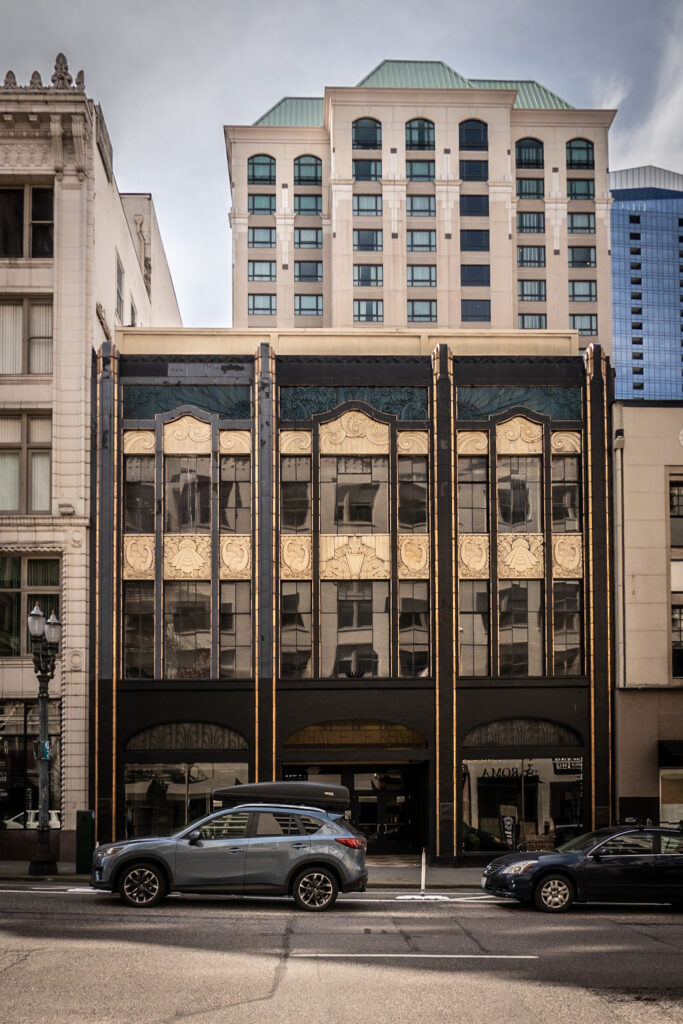
One of the most significant aspects of Portland’s Early architectural history was the city’s full and rigorous participation in the development of cast-iron architecture. The cast-iron era in both Europe and the United States, from the early 1840s through the l880s, coincided with the beginnings and early development of Portland. By coincidence, the construction of the first “Iron Front” in the United States and the erection of the first house on the site of what was to become Portland took place the same year —l842. In the fifty years that followed, approximately l60 of the 200 brick commercial structures erected in Portland are known to have used cast iron structurally or decoratively.
EARLY CAST-IRON CONSTRUCTION
The pioneers were astute in business matters, and they were aware of the new developments of the day, including the much heralded introduction of cast iron as a commercial building material. To the businessman, the advantages of cast-iron construction were obvious. Narrow cast-iron columns could replace heavy masonry piers between windows, allowing considerably more daylight to penetrate dim interiors. Moreover, the prefabricated iron parts could be erected more quickly, with decorative elements offering an owner boundless opportunity to decorate his building, adding significantly to the appearance of the city as well as reflecting his own material success. In pioneer Portland which lacked the armies of artisans that would have been needed to create buildings of equal complexity in stone or marble, cast iron had distinct advantages.
Iron had been used in architecture for thousands of years, but before the eighteenth century in only a limited way. In 1779 the English built the world’s first cast-iron bridge, designed by Thomas Pritchard, over the River Severn near Coalbrookdale, introducing to future engineers and architects the vast potential for the material. It was not until 1801, however, that iron was first used structurally in buildings. In that year, Boulton & Watt designed a cotton mill at Salford, England, utilizing cast-iron beams and columns. Development continued sporadically until 1851, when Joseph Paxton designed the Great Exhibition Hall in London, known as the Crystal Palace. This building, an incredibly vast and important structure, incorporated much of the engineering learned in bridge design and was proposed by Prince Albert.
The Crystal Palace, l,848 feet long, 456 feet across and 108 feet high, showed all the benefits of prefabrication and mass production, including considerable cost savings. Such remarkable architectural feats and the culture they proclaimed, profoundly impressed American readers. The new uses for this old material seemed unlimited.
For a variety of reasons English architects did not pursue the structural implications of cast iron with the erection of commercial structures. Although a few cast-iron buildings were erected in London and Glasgow in the late l850s, the limitations of the London building codes, popular tastes and criticism by influential critics such as John Ruskin, highly restricted development in England. It was to the inventive Americans that leadership in the full realization of the material passed.
Daniel D. Badger and James Bogardus were among the leaders in the American development of cast-iron construction. In l842 Daniel Badger founder and owner of the Architectural Iron Works, erected the first cast-iron storefront in Boston. Later, in l846, Badger moved his foundry to New York. There in l848 James Bogardus, foundryman, constructed an iron-fronted drugstore for John Millhau on lower Broadway. In l849 Bogardus constructed a similar but larger structure at the corner of Washington and Murray Streets in New York for Edgar H. Laing. Typically, these early structures utilized the traditional brick part wall with wood inner structure, but the facades were of cast iron.
A more important structure, also nearing completion in l849, boasted cast-iron construction throughout. This was the factory Bogardus designed for himself using an arcaded facade similar to those of the Millhau and Laing structures. The facade was integral with a complete system of iron columns and beams in the interior of the building. This structure hinted boldly at the whole future of American cast-iron architecture and led directly to a vast expansion of the use of iron in buildings. One such significant example was the dome of the United States Capitol, designed in l855 by Thomas Ustick Walter. Thereafter, not only were the foundries of Bogardus and Badger to boom, but countless others were established in New York and elsewhere. By l856 James Boardus was to codify these thoughts in his book, Cast-Iron Buildings, Their Construction and Advantages. Such contemporary tracts, along with the pattern books developed by the various foundries, became the bibles which spread the new word. The pattern books presented extraordinary designs such as that of the l854 Harper Brothers Printing Plant (designed by John B. Corlies in collaboration with Bogardus) or that of the l857 E.V. Haughwout & Company’s Store (designed by John P. Gaynor with iron from Badger’s Architectural Iron Works).
Such wonderful success was properly sanctioned and proclaimed by the distinguished writer Henry Van Brunt, who spoke in l859 before the American Institute of Architects: “The cheapness of iron, the rapidity and ease of workmanship, the readiness with which it may be made to assume almost any known form, instead of being, as Ruskin asserts, ‘so many obstacles on our already encumbered road,’ are qualities which, in he present state of society, render that metal especially precious as a means of popular architecture . . . It becomes us to look around us and to ask ourselves with special solicitude if in our architectural works we are expressing the character of the age in which we live.”
On the West Coast the advantages of cast-iron construction were quickly admitted. In San Francisco, flush with the wealth of the gold rush boom, several foundries were established during the l850s, including the Pacific Foundry, and Jonathan Kittredge’s Phoenix Iron Works. By the mid-l850s iron fronts were becoming the predominant architectural feature of construction in San Francisco. By the l870s the fabulous Palace Hotel designed by New York architect John P. Gaynor for William C. Ralston, boasted a chaste but superb interior court constructed in cast iron. Also in the l870s the Hinkley Foundry of San Francisco cast all the parts for a complete cast-iron building including the roof covering. (This happened to be the only cast-iron building in San Francisco to satisfactorily survive the disastrous fire following the l906 earthquake). Montgomery Street in l874, the Fifth Avenue of San Francisco, was lined with extravagant cast-iron fronted structures, up to six stories in height, adorned in the lavish style of the era.
The development of the cast-iron industry and the erection of cast-iron fronted buildings was remarkably parallel in the only other major city on the West Coast, Portland, Oregon. Indeed an early lithograph of Portland’s Front Avenue shows a scene very similar to San Francisco’s Montgomery Street, with row upon row of elaborate cast-iron structures. By the early l880s, however, San Francisco had far outstripped Portland in size and in its enormous collection of cast-iron fronted structures. It was only after the tragic San Francisco earthquake of l906 that Portland’s cast-iron collection became the largest on the West Coast. Today after years of demolition in other cities in the country, Portland’s collection remains the second largest, surpassed only by that of the New York City Soho Historic District.
THE GRAND ERA OF CAST-IRON IN PORTLAND
The first cast-iron for Portland’s buildings was supplied by foundries located in San Francisco. Architect A.B. Hallock, Portland’s first, represented the Phoenix Iron Works of San Francisco. Hallock designed the first brick commercial structure in the city in l853 (the W.S. Ladd Building) and at least sixteen other early brick buildings. He introduced the Phoenix Iron in the Kohn Building of l854, using iron window cornices, sill plates, door sills, and fire doors. And he used the city’s first iron pilaster columns on a structure he built for himself in l857 (a building that still stands minus the ironwork) and on the l853 Ladd Building when it was remodeled in l858. During the years to follow most of the buildings designed or remodeled by Hillock and others used cast-iron pilasters on the main floor facade. Until l864 most of the iron used in Portland was supplied by the Phoenix Iron Works the California Foundry, the Fulton Iron Works, or the Sutter Iron Works, all of San Francisco.
The cast-iron patterns used on the great majority of the early structures were remarkably similar. The basic element was a decorated front pilaster from 10-12 feet high and about l0 inches wide, with a Corinthian-style capital and a recessed panel on the shaft bearing a large cartouche or crest, bolted on at about half height. The base was integral with the casting and it was here that the manufacturer’s name was found, and possibly the date of the casting. This pleasant custom remained throughout the cast-iron era. The strength of the assembled pieces was achieved by bolting the cast-iron pilaster, with perpendicular iron stiffening plates behind them, to the cast-iron sill plates, which were attached to the top of the brick or stone footing wall. The tops of the pilasters were connected by cast-iron arches usually 6 feet from center to center of the pilasters. Typically the shelf formed by the fold of the iron arch supported the brick wall of the floors above. Other cast-iron elements included the bracketed cornice bolted to the face of the arch plate; the cornice and sill plates of upper floor windows; roof cornice medallions; and panel fire doors which folded tidily in their closed position into pockets behind the plaster face.
This standard pilaster design was used on the l864 Parrish Building, the first in Portland to use a cast-iron pilaster produced by a local foundry—in this case, David Monastes’ Portland Foundry. A similar pattern was used by architect E.M. Burton on the Oregon Steam Navigation Company buildings of l865. Burton is known to have contracted for iron work from the Architectural Iron Works of San Francisco, for his advertisement boasted that he could supply San Francisco iron at San Francisco prices.
When architect John Nestor arrived in Portland from San Francisco in 1864, he introduced several new patterns, then fashionable in San Francisco and on the East Coast. On the l865 Carter Building Nestor used much larger columns than had been seen in the city—columns almost l6 feet tall and spanning about 25 feet. These square columns were hollow iron, with a large cast-iron spandrel beam spanning the openings between and supporting the masonry structure above. Decorations on the columns were in the form of rustications, giving the appearance of individual carved stones piled one upon the other.
By l867 it was apparent that Portland foundries and iron works were able to meet the increasing demand for iron-fronted structures. Four foundries existed in the city: F. Monasties’ Portland Foundry (established in l853), the Oregon Iron Works (l863), the Willamette Iron Works (1865), and the Smith Brothers Foundry & Iron Works (later Smith & Watson, circa l865). The Oregonian of September l6, l868, reported that “the iron foundry business seems likely to become the leading feature of Oregon enterprises. There are four foundries in the city and they are all kept busy, some of them running day and night.”
The face of the city began to have a more cosmopolitan air. Front Street, lined for blocks with cast-iron structures, bore little resemblance to the wooden village of the l850s. Streets were being paved, sewer systems installed. No doubt the city was quite proud of its new appearance, and travelers returning from San Francisco compared Portland favorably. By l867 the Portland Directory was able to say: “It is to be hoped that the work of improving the style of architecture in Oregon will not rest here, but will go on improving until Portland may be numbered among the architectural cities of the Union.”
Portland’s founding fathers had achieved considerable prosperity in two decades of commercial development, and the desires for architectural embellishment was great. The building which was to kindle the greatest architectural pride for the city was the Ladd & Tilton Bank of l868, designed by John Nestor. The facade, patterned after a l6th century Italian library on the Piazza of St. Mark in Venice, was lavish with cast-iron arches and rusticated pilasters l5 feet in height. It was everything a solid banking house should be—reflecting stability, elegant appointments, an air of permanence and, hopefully, prosperity. Justly proud of Portland’s new jewel, city newspapers and periodicals reported on every detail of the structure, declaring it comparable, if not superior, to any similar buildings on the West Coast. Praises ranged even to the subtle effects of light and shade across the undulating facade. Portland stepped into a new, proud era, and many magnificent buildings were to follow.
Cast-iron patterns of the late l860s and l870s included many variants of the pilaster style as well as a number of new styles. Chief among these was the pattern introduced on the l868 Ankeny & Watson Building, where for the first time appeared a completely free-standing column, topped by a round arch. The column, in the Corinthian style, was simple and elegant with rusticated pilasters at the end walks, and was spanned by a full round arch. It recaptured the spirit of the Florentine Renaissance, relying on its appeal for fine proportions, excellent detailing, and reserved decorations. The abundant use of this column on many buildings lining Front and First Streets gave an architectural unity to the city never seen before or since. On some blocks, this pattern dominated both sides of the street. Indeed, the Lewis & Flanders Block and the Ankeny Block of l869, the Glisan Block of l869, and Smiths’ Block of l872 presented row after row of unified facades. Such vistas inspired the Oregonian to write in l871: “Many of these buildings are costly and of handsome and imposing appearance. We doubt if any city on the Pacific Coast can show anything like a parallel. The exhibit proves conclusively and in the most appreciable way the rapid strides of our city toward wealth and greatness.”
The free-standing column and arch attained special drama in the bold design for the entrances to the new Market Theater, erected in l872 from designs of W.W. Piper and E.M. Burton. The huge arches, spanning over 10 feet were designed primarily to allow for the passage of carriages to the main floor market. The columns, l9 inches in diameter and l3 feet in height, were in the Corinthian style, with full fluting and with rusticated rings encircling the lower portions. A spectacular product of the iron foundries, they most fortunately remain standing today in excellent condition.
Other examples of free-standing columns occurred in the l869 Gilman Block, the first building to have full Roman Corinthian columns on pedestals across the main floor elevation and at the street intersection corner, where pilasters usually capped brick end walls. Above the columns the masonry pilasters usually capped brick end walks. Above the columns the masonry structure was carried by a flat iron beam, decorated as a horizontal belt cornice. Similar columns were used on the Masonic Hall (1871) where at the second and third floor corners, groupings of three columns gave the appearance of added strength. Again, horizontal belt cornices separated the floor line but here they were only wood decorations backing on the brick wall behind. Another variant of the free-standing columns in the Corinthian pattern is to be found in the Porter & Wiegand Building (1868) and Wiberg Building (about l873). Both structures used pairs of iron columns, on tall pedestals, as supports for a flat cast-iron beam above. The effect of paired columns was especially rich but was not often used, probably due to excessive cost.
Such distinguished and varied structures were discussed within the city at great length, as indicated by the number of laudatory articles in the local newspapers and in the annual reviews of the Portland Directory. The Oregonian in l872 wrote of the newest architectural additions: “Another favorable indication that our people are progressive in their taste as well as in matters of enterprise, exists in the fact that a very marked change is observable in the styles adopted in the construction of buildings. All the latest and most modern graces of architectural harmony, beauty and effect are found combined in the useful and ornamental improvements of the city.”
A variation of the pilasters at the street-intersection corner of a building allowed the architect to continue the building’s facade from the main-street to the side-street wall. The pilaster could be mounted to the two sides of the corner as in the l869 Odd Fellows Temple or the l872 Smiths Block. Here the two pilasters met, forming a small, cutout recess at the corner. In more elaborate variants of this corner treatment, the two corner pilasters were actually separated by a diagonal or rounded corner piece placed between them. The Strowbridge Block of l873 is an excellent example of this corner treatment. In this cast, the treatment was applied to all three floors. A classic method of turning a corner, it was easily adapted to cast-iron pilaster design. More modest variants of the corner treatment are found in Dekum’s Block (1871) and in the still standing New Market Block, South Wing (1871), which used the same iron pilaster at the ground level. Here the pilasters were actually structural, being bolted together to resemble one solid column. They carried the horizontal beam spanning the structural bay with intermediate small columns to define the doorway and glassed openings.
During the mid-1870s several major structures were built using primarily the pilaster style. The most prominent of these was the enormous Union Block, commenced in 1879. Here appeared pilasters l6 feet high and only l8 inches wide, with capitals placed near the tops of the doors or within 4 feet of the tops. This pattern allowed the full height necessary to illuminate the interiors of the shops yet gave a line to the tops of the doors, which could be carried across the facade. At the tops of the pilasters was the belt cornice line, housing the structural beam behind it. The beam was usually sufficiently strong to span a full structural bay of 25 feet or more. To enhance the tall pilasters, decorative heads, bearing full Roman profiles, were introduced at the capitals. Such heads, prized today by collectors, varied greatly in design. On the lower shaft of the pilaster was a recessed panel with bolted-on decorations and at the bottom were indications of a raised pedestal base with flutings. The tall pilasters could be used to face the ends of structural walls, at the corners in combination with a corner panel and another pilaster, or in combination with additional columns and arches between them. The clarity of their design was determined by the imagination of the architect, and his degree of restraint with their many variations.
The structural inventiveness of architects and cast-iron manufacturers working together often produced novel arch designs. In l875 architects McCaw and Martin designed the Dekum & Reed Block using arches in a “T” shape. Invented either by the architects or by the iron manufacture J.R. Sims of San Francisco, the “T”s joined in mid span. The arch formed when the sections were bolted together was as strong as one made of a single casting; moreover, the small segments were more convenient to make and to transport to the job site. The “T” arches also alleviated various problems with iron shrinkage and warping. The innovative “T” technique was a natural expansion of the structural principles inherent to iron and it suggested a whole range of future possibilities. The same pattern was later used in the Starr Block (1882) and the Allen & Lewis Block (l882); and “T” arches can still be seen in the l00-foot-long facade of the Blagen Block (l888).
Manufacturers did offer a variety of single-pour arches (that is, arches cast in a single piece). The round arches of the Smiths Block (1872) were made in one piece, as were the shouldered arches that stretched for a hundred feet across the facade of the Cosmopolitan Block (1878). The single-pour arches were in all cases joined directly above and to the columns. One surviving example of the shouldered-arch pattern can be found on the relatively small, 25-foot-long facade of the Fechheimer & White Building (1885) at 233 SW Front Avenue. Clearly this versatile pattern was as well suited to small buildings as to large ones.
One further innovation in arch design is demonstrated in the unique facade of the Central Block (1879). Here the small-scale, free-standing columns, along with their single-pour arches, were made considerably more rigid by the addition of iron panels in the spandrels between the arches. These additional castings, often found in New York, initiate large blocks of masonry, as did the keystone, at the uppermost curve of the arch, although they are in this case structurally superfluous. The presence of these panels with their promise of added strength could indicate that additional floors were once planned for the building. This was certainly the case in a great number of early structures.
By the conclusion of the l870s, an impressive array of new buildings adorned the city. First Street was gradually replacing Front Street as the city’s main thoroughfare and the city was moving, inevitably, west, away from the river and towards the surrounding foothills. The l879 Oregon City Enterprise reported: “First Street presents a gay and festive scene and is encumbered with as much traffic, trading, strolling beauty, and ornamental wealth as was Kearney Street in San Francisco. We cannot bring to mind a proportionate population that carried itself with so much dignity and importance as the metropolis of Oregon does.” The city was to be enriched many times over during the following decade, for handsome structures of the greatest importance were still to be constructed.
In l861 San Francisco architect Clinton Day designed for Captain J.C. Ainsworth the impressive Ainsworth Block on the northwest corner of Third and Oak Streets. Day used cast iron to cover the entire facade of this three-story building, up to the roof cornice line, composing one of the most unified and cohesive of the cast-iron facades in Portland. In many earlier cast-iron front buildings there remained a curious imbalance between the thin columns at street level and the heavier masonry facade above. But here the architect resolved in a unique and harmonious way the problems of scale between the tall main-floor pilasters and columns l9 feet, 9 inches tall and the second and third floor iron work. The bold, square Corinthian columns of the main floor carried with great visual strength the smaller-scaled pilasters and columns of the arched openings above. Indeed, the Ainsworth Block gave expression to the developing concept of a balanced facade, hinting at a structural philosophy that was to emerge a full decade later in the architecture emanating from Chicago.
By l882 Warren H. Williams, early Portland’s most productive architect had designed a large half-block structure on Front Street for the Allen & Lewis Company. He was able to remain current with eastern architectural tastes which had veered away from the more classical forms in something called “modern gothic.” Practically no hint of classic or gothic architecture appeared in this style: rather, it consisted of an ingenious arrangement of geometric decorations applied to otherwise typical cast-iron structures. In the Allen & Lewis Block, the standard arched openings, six between each structural or party wall, had free-standing columns with structural “T” arches above. The party walls had large iron pilasters with profuse bolted-on modern gothic detailing. Gothic influence was also evident in Italian pointed window openings on the third floor and in pointed chimney caps at the roof line. Portland’s only earlier example of the modern gothic style was the 1879 Bishop’s House on Stark Street, possibly designed by P. Heurn of San Francisco, who was the architect for the Catholic Cathedral located to its immediate west. Although the large upper-floor windows of the Bishop’s House uses gothic tracery, the main door cast-iron pilasters have geometric decorations similar to those used by Williams on the Allen & Lewis Block.
The taste for modern gothic was manifested in still other structures built during the l880s. The Ladd Block of l881 and Green’s Building of l882, identical structures have modern gothic decorations. Here pilaster bases have fluted decorations and pointed gothic arches appear in paired windows above the entrances. However, pronounced Mansard roofs with pointed iron balustrade railings, reveal a mixture in influences, creating rich and extraordinary effects. Constructed in l883 and still standing today was the Bickel Block, with pilasters quite similar to those of the l882 Allen & Lewis Block-resplendent with geometric invention, with decorations at the capital line suggestive of Corinthian foliage. The Architectural Iron Works of San Francisco supplied the best iron for these pilasters which are nearly l8 feet high.
The l880s certainly produced the most lavish structures ever to be seen in the city. Such opulence of construction demonstrated Portland’s great faith in its institutions and indeed in the future. The wealthy spared no expense in the creation of commercial palaces and in their own homes, the proud emblems of their achievements and their positions in the community. In l885 Northwest Illustrated Monthly Magazine gave credit to the architectural strides made by the city: “Portland is one of the least advertised cities on the American Continent, thus it happens that the traveler is not prepared to see in these “far Western Wilds” (wilds only in the minds of the uninformed) a city of metropolitan appearance built with architectural beauty and variety that would do credit to cities of 250,000 inhabitants.”
The two largest and most ornate structures erected in the l880s were the Starr Block (1882) and Kamm Block (1884). Both were four-story structures covering nearly half a city block, and both boasted observation towers. The former, towering 146 feet above the street and the latter, 125 feet, were soon familiar in etchings and early photographs offering general views of the city. Dotting the skyline, they stood alone with the city’s church spires, in a most decorative manner.
The Starr Block had a nearly 200 foot frontage on First Street. Architect Warren H Williams designed “Italian Renaissance” cast-iron columns for the lower floor, spanned with “T” type shouldered arches. The detailing of the rest of the buildings, especially in the arches of the windows, in the paired pilasters between them and in the fine roof cornice line, certainly reflected Renaissance influence. But with the elongated corner tower, a new adaption of classic design was evolved.
By contrast the Kamm Block designed in l884 by Justus Krummbein for Jacob Kamm was in the popular gothic style. However, like the other structures, it paid little attention to accurate historical detail. Gothic influences appeared in large gothic-style windows over the main entrance doorway. Even at the roof cornice huge wooden figures of Hermes supported cornice brackets. The effect was one of total magnificence, surpassing anything so far imagined for the city.
Among the richest facades of this somewhat baroque period of Portland’s architecture was that of a building designed by Warren H. Williams for James W. Cook on Front Street in l882. The free-standing Corinthian style columns lining the lower floor of this building were masterworks from the cast-iron foundries. Each richly ornate column, standing on a high pedestal, was connected by an iron tie to a cast-iron pilaster behind it. The spandrel panels between the arches were filled with lush foliage and modeled heads, and the keystones of the arches were heavy with scrollwork and leaf decorations. Fine cast-iron heads filled the tympanum of the rounded pediments at the roof cornice line, and they in turn were topped by towered parapet decorations bearing the owner’s name and the date of construction. No other building probably showed a more consistent control in the use of lavish decoration than the Kamm Block and surely it marked an unrivaled moment in Portland’s architectural history.
In the l880s the ever expanding city filled in the blocks between the Willamette River and Fourth Street until cast-iron columns lined almost every block. Other notable structures of the period were the Merchants Hotel (1880), the Johnson Building (1883), the Worcester Block (1883), the Cambridge Block (1884), the Portland Savings Bank (1885), the Abington (1886), and the Blagen Block (1886). Most of these reiterated the formulae and the column patterns of earlier structures. The last building to utilize cast iron for the upper floors was the Portland Savings Bank of l885.
Usually windows pierced brick walls and the pier between the windows was treated as a pilaster or pairs of pilasters or was simply stuccoed to suggest a wide column. Most upper-floor window arches were capped with iron keystones and iron decorations were placed at the capitals of the pilasters or in the spandrel panels between the arches. All the later cast-iron fronted structures had galvanized sheet-metal cornices, produced by such companies as J.C. Bayer or Brandt & Leck. The Portland Art Metal Works, owned by K.K. Tuerch, often provided ornamental work for interiors and exteriors, including elevator enclosures, bank and office railings, gates and lamps.
The last structure in the city to use cast-iron pilasters and columns was a rather modest building constructed by Rodney Glisan in l889. Its decorations were reminiscent of the modern gothic style but had curious derivatives of art nouveau. The grand era of cast-iron had come to a close and in the same year just to the north of Glisan’s building, construction was under way on the New Market Annex—a bold introduction to the tastes in architecture coming from Chicago. The new style scorned the scale, proportions and materials of the cast-iron era and developed an aesthetic that was far more reasonable for the taller structures of the future. Now the individual windows, formerly trapped between structural bays, were combined into a large bank of windows, and walls were rough-cut stone and brick. Decorations were still rich, but they were designed to look as if they grew out of the building, not as if they were applied. A new wave broke into the Portland architectural scene with possibilities as exciting to the new architects as those of cast iron had been to the old. The great question was: Would the real worth of the old be appreciated in the onrush of the new? Would the historical importance of cast-iron be placed in perspective soon enough to ensure its survival?
THE WRECKER’S ZEAL
After the turn of the century, the business core of the city continued to move west, away from the river to Fourth and Fifth Streets, and the stately avenues of cast-iron facades began a slow but inevitable decline. Tenants occupied most of the structures well into the l920s; indeed, some of the old business houses maintained their cast-iron headquarters well into the 1930s and 1940s. Continued interest in the structures was manifested in numerous articles describing the romantic, somewhat European appeal of the area and calling for special protection of the area around the Skidmore Fountain. Artists, photographers and a good many admirers continued to explore the older sections of the city.
But what the wars did to European cities and the great earthquake of 1906 did to San Francisco, “progress” did to Portland. For a long sequence of city “improvements” suggested from the early 1900s through the 1950s entailed all but the elimination of the area. Combined with rising property taxes, which heavily encumbered the continued utilization of the buildings and hindered improvements, destructive forces were at work with which property owners could no longer contend. The construction of a riverfront expressway meant that all the structures along the river side of Front Street had to be demolished. No one challenged progress; it was the city’s sacred cow. Newspapers continued to chronicle the changes with articles such as “Romantic Portland Streets” (April 5, 1934) and “Where Old and New Meet in Camaraderie” (March l6, l935). But despite public appreciation of the endangered areas destruction began on a large scale in the early l940s. “Portland’s almost last link with the dusty past is about to go. The ornate façade fronts of Front Avenue Buildings will fall to the wreckers zeal and in their place will rise the austere severity of modern architecture. The cobblestones of the narrow streets will disappear under the paving of the new super-highway and the last gas mantle lamp will metamorphize into neon. So look your last, Portland, as old Front Avenue goes glimmering. A new day is coming!”
The waterfront super-highway did move cars—until 1974, when all agreed that it was a crime to place a major roadway alongside the Willamette River, separating the city from its most important asset. The area is now replanted and is becoming a fine waterfront park.
The new bridge construction finished the job of destroying the long row of historic structures lining the waterfront. In the l950s the first buildings erected in the city, and many others of historical significance still stood in their original locations—somewhat untidy, not always rented but still structurally sound. Then the Morrison Bridge ramps devastated three entire blocks of historic structures. The Hawthorne Bridge ramps did likewise, mostly to carry cars to Harbor Drive, which of course is now gone and forgotten along with the ramps themselves.
The historic area was at last totally devastated but no new structures were constructed as predicted. Instead the area is still desolate today. Photos of the area resemble Dresden after the war, with plenty of space for parked automobiles. What remained were certain structures around the Skidmore Fountain, and a few others clustered around First and Yamhill Streets. Civic indifference next took its toll in the Skidmore Fountain area. And where the florentine elegances of the Lewis & Flanders Block and the Ankeny Block once graced the entire Fountain area, the city erected the Central Fire Station, a building of total architectural banality.
Today twenty cast-iron structures remain from the most remarkable period of early growth in the city. They desperately need the controls that historic designation can afford. Growing numbers of Portlanders are concerned about what is happening to the face of the city. Today height is too often a builder’s first standard and new structures tend to be devoid of evidence of human street activity and artistic invention. Portland needs the evidence of its beginnings, properly so because we are by no means replacing the art the city once had in its structures. Those long rows of cast-iron fronted structures, profuse with the art work of an era, were of real value and their loss should be a lesson.
Taken from – The Grand Era of Cast Iron Architecture in Portland:
Written by William Hawkins, Binford, 1976, pp 12-25, with the kind permission of William Hawkins, January 1992.