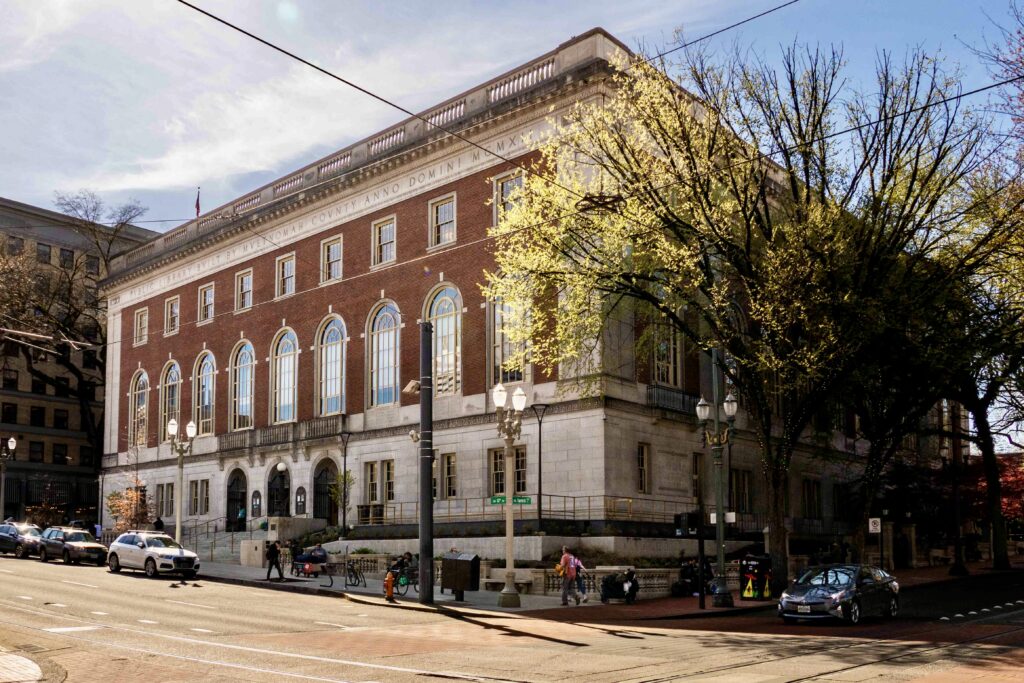
A. E. Doyle was the most important architect in Portland, Oregon in the first quarter of the twentieth century. His firm was responsible for the design of a majority of the major downtown buildings, as well as a wide variety of institutional, educational, and residential structures.
Doyle was born in Santa Cruz, California in 1877. While still a young child, he moved with his family to Portland, Oregon. In 1893, soon after completing eighth grade, Doyle began working for Portland’s leading architects, Whidden & Lewis. He remained at the firm as a drafter through 1905, with the exception of the two years spent in New York working for Henry Bacon (today best known for his design of the Lincoln Memorial). In 1906 Doyle traveled in Europe. The next year he opened his own architectural office.
A. E. Doyle, as he was known professionally, was fortunate to start his practice just as Portland was beginning a building boom. With his knowledge of European precedents and his recent experience in New York, Doyle was the Portland architect best prepared to take on the challenges of the new steel-framed downtown buildings. He also had an affable, ingratiating personality and proved adept at cultivating the city’s business and cultural elite. Doyle quickly received commissions for large buildings and, at some point in 1907, probably to manage his sudden success, he formed a partnership with another local architect, William B. Patterson. Patterson served as engineer and project superintendent, freeing Doyle to focus primarily on client development and design. Over the next seven years, Doyle & Patterson was responsible for thirteen major downtown buildings, including department stores, office blocks, hotels and the central library. In 1911 the firm provided a campus plan for the new Reed College and thereafter designed the first campus buildings. (From 1911 to 1913 a third partner was added, engineer James Beach, and the firm was called Doyle, Patterson & Beach.)
Like other successful architects of his generation, Doyle was skilled in designing in multiple styles. Many of his downtown buildings were clad in white terra cotta and these typically drew on classical precedents. The Reed College buildings were brick structures that can be characterized as collegiate gothic. Doyle also designed residential buildings; several cottages of his design at the coastal resort of Neahkahnie would inspire a later generation of Oregon architects seeking an appropriate modern regional mode.
As the economy declined after 1912, Doyle’s firm was scaled back and the partnership came to an end in 1915. For several years, Doyle practiced with just a few employees, but in the 1920s, his firm had a second period of growth and he designed several more large downtown office buildings. Most drew from the precedent of the Renaissance palazzo. The Pacific Building (1926) is notable for the simplicity of its rectilinear expression and its minimal detail. In 1925, Doyle hired the young Pietro Belluschi, which gave the latter his start as an architect. Doyle died in Portland in 1928. The firm continued as A.E. Doyle & Associates until 1943, when the name was changed to Pietro Belluschi, Architect.