ART DECO – HISTORY AND INFLUENCE
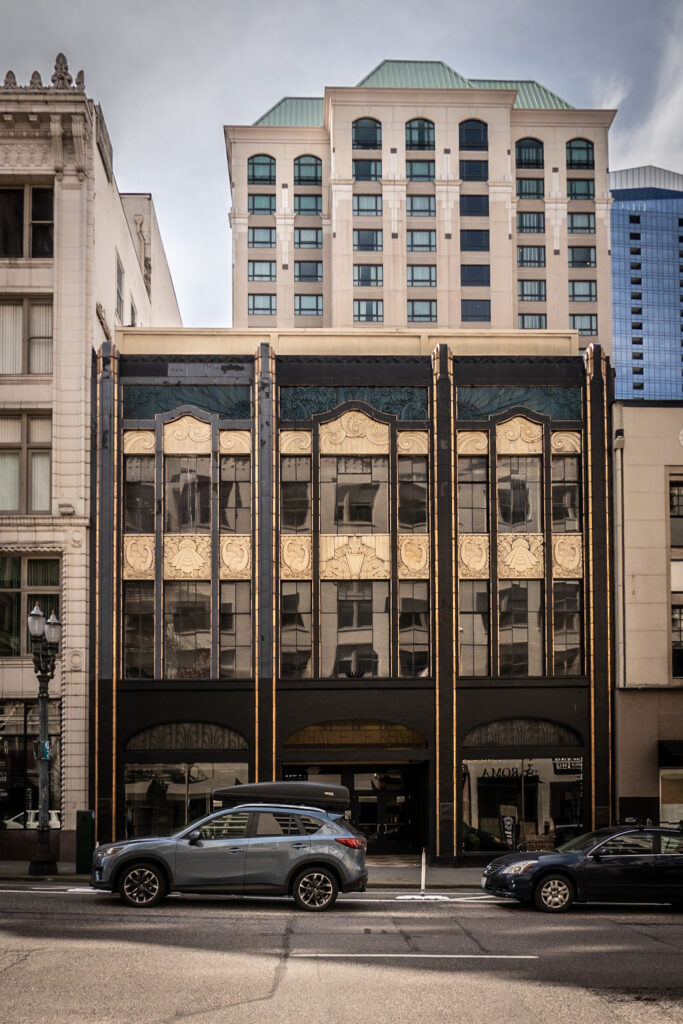
The Art Deco style architecture evolved into two forms, each with many variants; the Perpendicular style, represented in the Charles F. Berg building; and the horizontal streamlined style which emphasized the horizontal line. Several examples of this horizontal style were built in Portland during the twenties and thirties when this style was popular but have since been destroyed. Art Deco was very popular, and there would undoubtedly have been much greater use of that style here in Portland, had it not been for the influence of A.E. Doyle who was a strong proponent of the classical styles.
Art Deco was born out of a decorative movement in European architecture called Art Nouveau, that flourished in the 1880’s through the early 1900’s. Its characteristics were a flowing and sinuous naturalistic ornamentation and an avoidance of historical architectural traits. It was a futuristic look at design, responding to the aesthetics of the machine age and broke all ties to traditional art. The style is identified by stepped or flat roofs, curved decorative elements, asymmetrical composition, large windows with metal sashes, polychrome surface covering a steel or concrete frame, geometric ornamentation in low relief including chevrons, zigzags, fluting, sunbursts, vertical and horizontal banding (spandrels), and stylized figure sculpture. Art Deco went by other names in European countries, where it was know as Le Modern Style (France), Jugenstil (Germany and Austria), and Stile Liberty (Italy). This new look became the American Style in the 1920’s and 30’s in buildings, movie theaters, fabric, furniture, light fixtures, and cars.
The Art Deco style architecture evolved into two forms, each with many variants; the Perpendicular style, represented in the Charles F. Berg building; and the horizontal streamlined style which emphasized the horizontal line. Several examples of this horizontal style were built in Portland during the twenties and thirties when this style was popular but have since been destroyed. Art Deco was very popular, and there would undoubtedly have been much greater use of that style here in Portland, had it not been for the influence of A.E. Doyle who was a strong proponent of the classical styles.
The Art Deco influence (called Neo-Art Deco) can be seen in more recent buildings in the Portland area, such as the KOIN Tower, SW 3rd and Columbia, designed by Zimmer/Gumsul/Frasca Architects, the Portland Building, designed by Michael Graves, and the capitals of the columns around Pioneer Courthouse Square.